
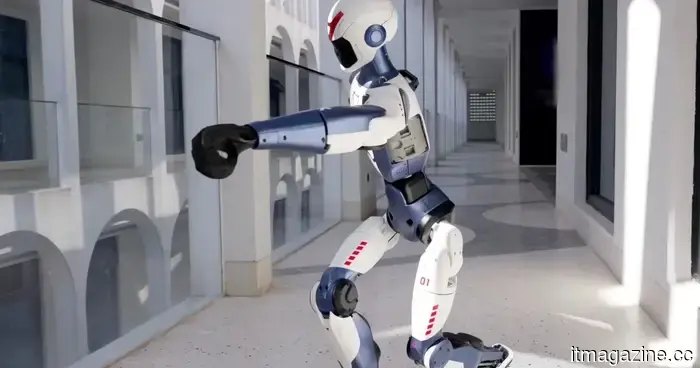
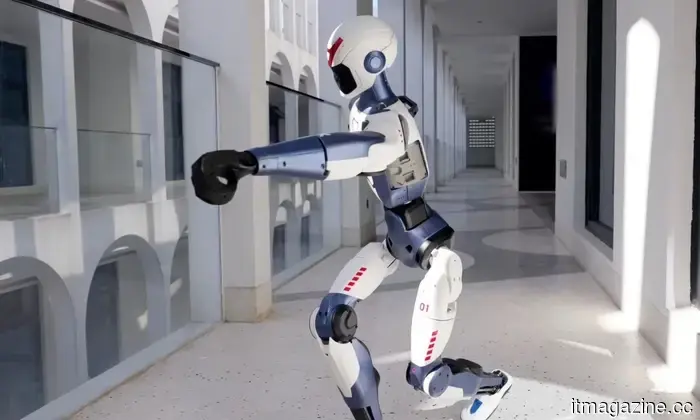
This incredibly inexpensive, tumbling humanoid robot might be making its way to the US.
Unitree's R1 humanoid robot combines a surprisingly low price with remarkable agility, and it may soon expand beyond China to reach global markets.
China's Unitree Robotics is reportedly getting ready to introduce its most affordable humanoid robot to the international market. Industry insiders indicate that a worldwide launch, including a potential release in the US, could be forthcoming.
What features does the Unitree R1 have?
Introduced last year, the Unitree R1 is among the most inexpensive humanoid robots available, starting at roughly $4,900. This price point is significantly lower compared to most current humanoid robots, which generally fall within the five-figure range.
Even with its affordable price, the R1 doesn't compromise on performance. It stands about 1.2 meters tall and weighs between 25-27 kg, making it a reasonably compact and lightweight humanoid machine. It boasts 26 joints for versatile movement and is equipped with onboard computing that can facilitate voice and image interactions.
Thanks to its light build, the R1 is highly agile. Unitree has demonstrated its ability to perform cartwheels, run, kick, and even rise from the ground unaided, underscoring its emphasis on mobility and balance.
Currently, the robot is restricted to the Chinese market. However, the South China Morning Post notes that Unitree may soon broaden its availability worldwide by listing the robot on AliExpress. While the company has not yet revealed details on international pricing or regional distribution, the report indicates that the robot could be accessible in key markets such as the US, Europe, Japan, and Singapore.
Why is this potential global launch significant?
If Unitree proceeds with an international launch, the R1 could greatly decrease barriers for entry into the realm of humanoid robots. Offering a relatively advanced machine at this price in global markets would enhance accessibility for developers, researchers, and hobbyists alike.
More affordable pricing paired with greater availability could stimulate additional real-world experimentation beyond controlled environments. Nonetheless, even if Unitree opens sales to a wider audience, practical applications for the average consumer may still be limited. At present, the R1 is more suited for research and development rather than everyday functions, making it likely to attract early adopters rather than mainstream buyers.
Pranob is an experienced tech journalist with over eight years covering consumer technology. His work has been…
OpenAI is facing investigation regarding concerns with ChatGPT.
A new investigation raises safety questions about ChatGPT. Just as it appeared OpenAI was on the brink of its next significant advancement, potentially even an IPO, the organization is now dealing with serious scrutiny. This time, the criticism is coming not just from online voices but involves an official government inquiry, intensifying the situation.
OpenAI is currently under a noteworthy investigation.
ChatGPT has introduced a $100 plan, tailored for specific power users.
In the midst of ChatGPT's escalating pricing complexities, OpenAI has added another tier, this one set at $100 per month. This plan isn't arbitrary; it's explicitly designed for a distinct type of user—those who are already utilizing ChatGPT to its full potential.
Your smartwatch may soon enable you to control your PC using hand gestures.
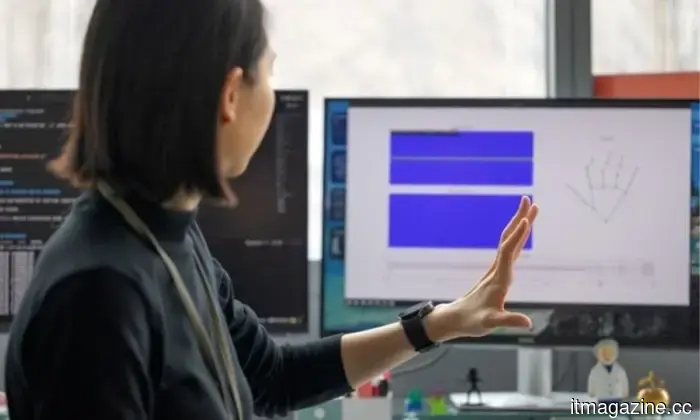
Can a smartwatch effectively replace a mouse? Research suggests it can. Researchers from Cornell University and KAIST in South Korea have developed a system called WatchHand that transforms any conventional smartwatch into a hand-tracking device. The best part is that this doesn’t necessitate any additional hardware. According to their published findings, the technology employs AI-powered micro sonar to track hand movements and finger positions in real time, utilizing the existing hardware of your smartwatch.



Other articles
 Oracle has named Hilary Maxson as CFO to oversee its $50 billion investment in AI data centers.
Hilary Maxson, who previously served as group CFO at Schneider Electric, is joining Oracle as the company announces the reduction of 30,000 jobs and a $50 billion investment in AI data center development.
Oracle has named Hilary Maxson as CFO to oversee its $50 billion investment in AI data centers.
Hilary Maxson, who previously served as group CFO at Schneider Electric, is joining Oracle as the company announces the reduction of 30,000 jobs and a $50 billion investment in AI data center development.
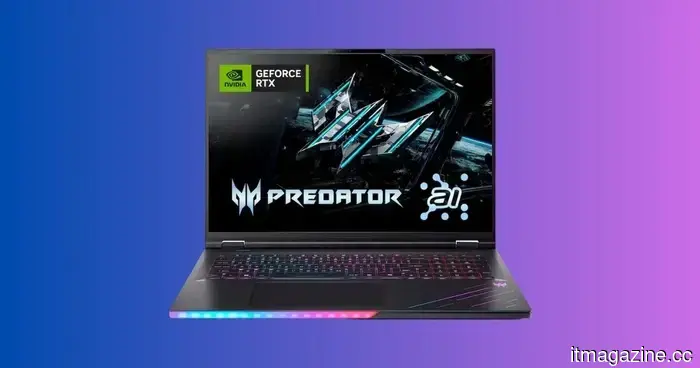 Get $560 off the Acer Predator Helios 18 AI, featuring an RTX 5080, a 24-core Ultra 9 processor, and a 250Hz Mini-LED display for less than $2,600.
The Acer Predator Helios 18 AI is now available for $2,539.99, offering a savings of $560 from its comparable price of $3,099.99. It features an impressive specification sheet that includes an RTX 5080 with GDDR7, a 24-core Intel Core Ultra 9, and a 250Hz Mini-LED display with 1000 nits that come together to [...]
Get $560 off the Acer Predator Helios 18 AI, featuring an RTX 5080, a 24-core Ultra 9 processor, and a 250Hz Mini-LED display for less than $2,600.
The Acer Predator Helios 18 AI is now available for $2,539.99, offering a savings of $560 from its comparable price of $3,099.99. It features an impressive specification sheet that includes an RTX 5080 with GDDR7, a 24-core Intel Core Ultra 9, and a 250Hz Mini-LED display with 1000 nits that come together to [...]
 Oracle appoints Hilary Maxson as Chief Financial Officer to oversee its $50 billion investment in AI data centers.
Hilary Maxson, who previously served as group CFO at Schneider Electric, is now joining Oracle as the company announces a reduction of 30,000 jobs and pledges $50 billion towards the construction of AI data centers.
Oracle appoints Hilary Maxson as Chief Financial Officer to oversee its $50 billion investment in AI data centers.
Hilary Maxson, who previously served as group CFO at Schneider Electric, is now joining Oracle as the company announces a reduction of 30,000 jobs and pledges $50 billion towards the construction of AI data centers.
 Oracle has named Hilary Maxson as CFO to oversee its $50 billion investment in AI data centers.
Hilary Maxson, who previously held the position of group CFO at Schneider Electric, has joined Oracle as the company reduces its workforce by 30,000 employees and pledges $50 billion towards the construction of AI data centers.
Oracle has named Hilary Maxson as CFO to oversee its $50 billion investment in AI data centers.
Hilary Maxson, who previously held the position of group CFO at Schneider Electric, has joined Oracle as the company reduces its workforce by 30,000 employees and pledges $50 billion towards the construction of AI data centers.
 Jassy states that Amazon's chip division could be valued at $50 billion and suggests that there may be plans to sell them to external customers.
In his 2026 shareholder letter, Andy Jassy discloses that Amazon's Graviton, Trainium, and Nitro chips generate over $20 billion annually and may potentially be marketed directly to third parties.
Jassy states that Amazon's chip division could be valued at $50 billion and suggests that there may be plans to sell them to external customers.
In his 2026 shareholder letter, Andy Jassy discloses that Amazon's Graviton, Trainium, and Nitro chips generate over $20 billion annually and may potentially be marketed directly to third parties.
 According to Jassy, Amazon's chip division could be valued at $50 billion, and he suggests that there is a possibility of selling them to external clients.
Andy Jassy's shareholder letter for 2026 highlights that Amazon's Graviton, Trainium, and Nitro chips generate over $20 billion annually and have the potential to be sold directly to third-party clients.
According to Jassy, Amazon's chip division could be valued at $50 billion, and he suggests that there is a possibility of selling them to external clients.
Andy Jassy's shareholder letter for 2026 highlights that Amazon's Graviton, Trainium, and Nitro chips generate over $20 billion annually and have the potential to be sold directly to third-party clients.
This incredibly inexpensive, tumbling humanoid robot might be making its way to the US.
Unitree's R1, one of the most budget-friendly humanoid robots available, may soon be introduced to international markets, including the United States.