
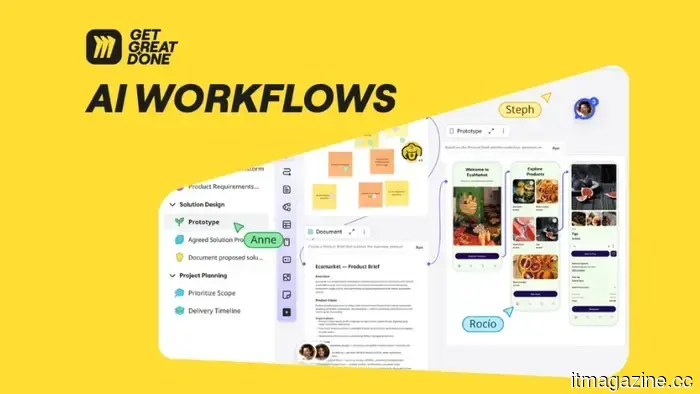
Miro now integrates AI agents into your team's whiteboard.
There is a unique frustration that arises when you input context into an AI tool that your team has spent three days organizing on a whiteboard. You transfer sticky notes into a prompt, describe diagrams, attempt to clarify the connections between concepts that were clear when visually mapped out, and observe the subtleties dissipate into a simple paragraph. The visual brainstorming that made the session effective vanishes as soon as you step away from the board.
This article includes affiliate links. Should you make a purchase through these links, we might earn a commission at no added cost to you.
Miro, a visual collaboration platform utilized by over 100 million people across 250,000 organizations, has swiftly been working towards a solution to this issue. In January 2026, it introduced AI Workflows: a set of AI agents that operate directly on the canvas where teams already collaborate, using everything present on the board for context. No need to copy content, create prompts from scratch, or switch between tools. The AI perceives what your team sees. Furthermore, in March 2026, Miro acquired Reforge, a company that focuses on product strategy and growth education, indicating its intention to combine AI collaboration tools with the frameworks teams require for effective usage.
Why many AI tools do not serve teams effectively
The disparity between individual AI productivity and collective team productivity has emerged as a significant issue in enterprise software. According to Miro's own research, three-quarters of global business leaders believe most AI tools concentrate too much on individual tasks, while 82 percent seek solutions that enhance team productivity. This aligns with the daily experiences of most knowledge workers: an AI assistant that aids in drafting documents is beneficial, but it cannot substitute for the collaborative effort of getting a cross-functional team aligned on what the document should initially articulate.
Most AI tools function independently. Users prompt them one at a time, receive individual outputs, and then invest further time aligning those outputs with the team. Historically, the canvas, where ideas develop visually and collaboratively, has been devoid of AI. Miro's proposition is that integrating AI directly into that shared space transforms the dynamic entirely.
Sidekicks and Flows: AI that operates on the board
Miro's AI Workflows consist of two primary elements: Sidekicks and Flows.
Sidekicks are conversational AI agents residing on the canvas. They do not necessitate meticulously crafted prompts because they already grasp the multimodal context around them: sticky notes, diagrams, documents, images, tables, and the spatial connections among them. Think of them as collaborators who arrive having already comprehended everything displayed within the room. Sidekicks can be customized with specific skills and knowledge bases, allowing a product team's Sidekick to interpret its domain differently from a marketing team's.
Flows are multi-step visual workflows that connect AI actions while ensuring human involvement at every phase. A product team might create a Flow that organizes a collection of user research notes, groups them by themes, generates summary insights, and drafts a product brief, all on the same canvas where the original research exists. The team can intervene, redirect, or adjust at any point. Early users report reducing their innovation cycles from weeks to mere hours, with total delivery cost reductions exceeding 50 percent.
The synergy of these features is more significant than either element alone. Sidekicks manage the conversational, contextual tasks. Flows take care of the repeatable, multi-step procedures. Together, they transform a collaborative whiteboard into something akin to an AI-enhanced operating system for team collaboration.
What teams are actually creating with it
The use cases that have quickly gained traction tend to follow a consistent pattern: disorganized collaborative input transformed into organized, shareable output.
Product teams utilize Flows to turn brainstorming sessions into prioritized roadmaps. Design teams connect Miro’s canvas to Figma through the new prototype export feature, allowing architecture diagrams and wireframes to seamlessly transition into design files. Engineering teams are implementing Miro’s MCP server (currently in beta, developed in partnership with Anthropic, AWS, GitHub, Google, and Windsurf) to link boards with AI coding tools like Cursor, Claude Code, and GitHub Copilot. As a result, system architecture diagrams on the canvas serve as the foundation for AI-generated code that accurately reflects the intended design, as the coding agent can view the board.
Workshop facilitators are turning to Miro Engage, a beta tool designed to transform passive participants into active contributors during meetings, all-hands events, and training sessions. Meanwhile, the new AI Slides feature allows users to generate presentation decks using board content, meaning the results of a working session can directly become a stakeholder presentation without spending hours reformatting.
These are practical applications already in use by teams at companies such as PepsiCo, ASOS, and Deloitte.
The pricing details
Miro’s free plan still exists and is genuinely useful: it allows unlimited team members, three editable boards, and access
Other articles
 Intel teams up with Musk's Terafab as a foundry partner in a $25 billion chip megaproject.
Intel has agreed to participate in Elon Musk's $25 billion Terafab project alongside SpaceX and Tesla, utilizing its 18A process technology to aim for a terawatt of AI computing annually in Austin, Texas.
Intel teams up with Musk's Terafab as a foundry partner in a $25 billion chip megaproject.
Intel has agreed to participate in Elon Musk's $25 billion Terafab project alongside SpaceX and Tesla, utilizing its 18A process technology to aim for a terawatt of AI computing annually in Austin, Texas.
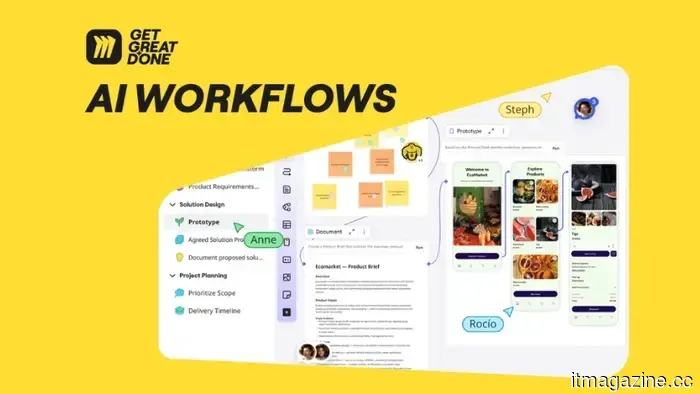 Miro now integrates AI agents onto your team's whiteboard.
Miro's AI Workflows transform visual brainstorming sessions into completed deliverables. With Sidekicks and Flows, the innovation process is shortened from weeks to hours for over 250,000 companies.
Miro now integrates AI agents onto your team's whiteboard.
Miro's AI Workflows transform visual brainstorming sessions into completed deliverables. With Sidekicks and Flows, the innovation process is shortened from weeks to hours for over 250,000 companies.
 Pixel surpasses iPhone and Galaxy in terms of repairability.
A recent 2026 repairability report alters the rankings of smartphones, placing the Google Pixel above iPhone and Galaxy models. Meanwhile, more stringent EU scoring highlights how design decisions impact long-term usability and repair expenses.
Pixel surpasses iPhone and Galaxy in terms of repairability.
A recent 2026 repairability report alters the rankings of smartphones, placing the Google Pixel above iPhone and Galaxy models. Meanwhile, more stringent EU scoring highlights how design decisions impact long-term usability and repair expenses.
 Pixel surpasses iPhone and Galaxy in terms of repairability.
A recent 2026 repairability report alters the rankings of smartphones, placing the Google Pixel above iPhone and Galaxy models. Additionally, more rigorous EU scoring reveals how design decisions impact long-term usability and repair expenses.
Pixel surpasses iPhone and Galaxy in terms of repairability.
A recent 2026 repairability report alters the rankings of smartphones, placing the Google Pixel above iPhone and Galaxy models. Additionally, more rigorous EU scoring reveals how design decisions impact long-term usability and repair expenses.
 This PS3 emulator has just released its official PC requirements, and they are quite straightforward to fulfill.
The official system requirements for RPCS3 indicate that PS3 emulation is more attainable than anticipated, as even basic PCs and handheld devices can run numerous games with good performance.
This PS3 emulator has just released its official PC requirements, and they are quite straightforward to fulfill.
The official system requirements for RPCS3 indicate that PS3 emulation is more attainable than anticipated, as even basic PCs and handheld devices can run numerous games with good performance.
 DeepSeek V4 might be released this month, as indicated by the test interface which hints at Vision and Expert modes.
In China's domestic large model sector, DeepSeek V4 is certainly one of the most awaited releases in recent months. Following its launch,
DeepSeek V4 might be released this month, as indicated by the test interface which hints at Vision and Expert modes.
In China's domestic large model sector, DeepSeek V4 is certainly one of the most awaited releases in recent months. Following its launch,
Miro now integrates AI agents into your team's whiteboard.
Miro's AI Workflows transform visual brainstorming sessions into completed deliverables. Sidekicks and Flows reduce innovation cycles from weeks to hours for over 250,000 businesses.