
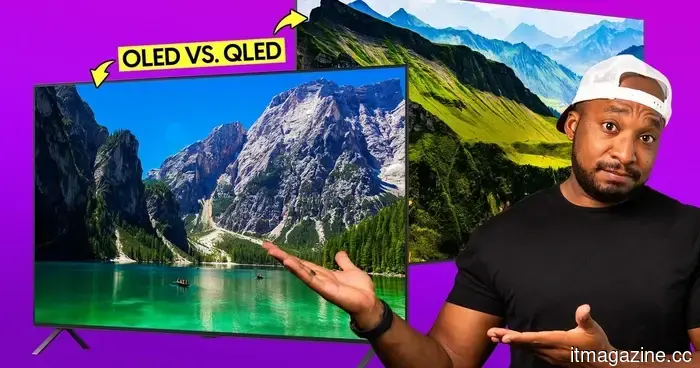
You Inquired: Comparison of OLED and QLED at a distance and resolving Dolby Atmos problems.
On today's episode of You Asked: What is the expected lifespan of your OLED TV? Will you really perceive differences among various types of TVs? And why isn't Dolby Atmos transmitting from your Blu-ray player to your sound system?
Can you identify the differences between OLED and QLED from a distance?
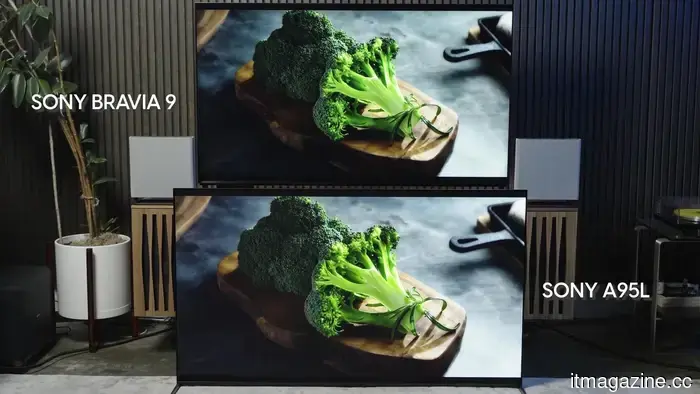
QLED vs OLED: Bravia 9 vs Sony A95L Zeke Jones / Digital Trends
@mk1976mk inquires: Can an average person seated 15 feet away genuinely notice the difference (between OLED and QLED)?
If the TVs are placed side by side, yes, you’ll perceive a difference, particularly with HDR or content that features high contrast. The disparity in black levels is noticeable, especially in person. Additionally, you’ll likely see a difference in color, which complements contrast. As contrast increases, so do color saturation levels. Therefore, OLED often has the upper hand in many scenarios.
However, in terms of brightness, if you require it in a room with windows, a QLED TV might have the edge.
If the TVs are not positioned side by side, you probably wouldn't realize what you're missing unless you've previously owned an OLED TV for a while and have become accustomed to its display. Practically every TV we discuss, including many QLED models that continually enhance contrast year after year, looks impressive on its own and would satisfy 99 percent of viewers with its picture quality.
What is the expected lifespan of an OLED TV?
LG C1 OLED Dan Baker / Digital Trends
@freg1959 asks: I purchased an LG C1 new in December 2021, and I’m curious about how long this model should last. I average about 10 hours of use per day.
The good news is that I believe it will serve you well for a considerable time, whether you desire it to or not.
According to Consumer Affairs, LG asserts that their OLEDs can last up to 100,000 hours. Other sources estimate between 30,000 and 100,000 hours. That's quite a broad range, but let's do the calculations. If you use the TV for 10 hours daily over a year, that totals 3,650 hours annually. To reach the lower end of that range, it would take more than eight years. To reach 100,000 hours at that rate would take over 27 years.
It's obvious that 100,000 hours raises questions about what condition level that means. I certainly wouldn’t expect the picture quality to remain as it was during its first few years. And who realistically holds onto a TV for 27 years? Though some of our parents may have tried.
Regarding your LG OLED, I would be more concerned about the type of content being watched during those 10 hours daily. If you frequently watch content with static logos on the screen, such as sports, news, or gaming, be sure to utilize LG’s OLED care options.
Why isn’t Dolby Atmos functioning correctly?
Digital Trends
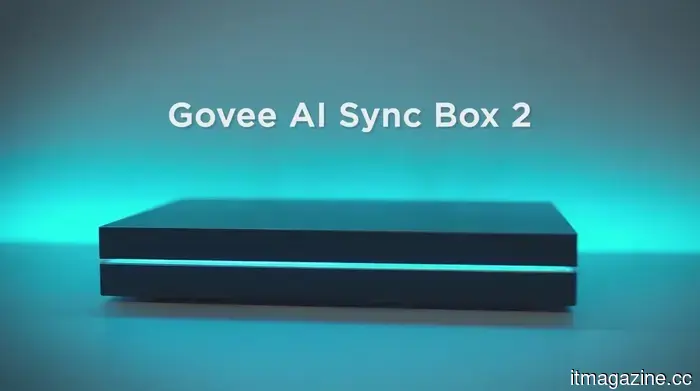
Sebastian asks: Hello, I have a question about my home theater setup. To provide context, my PlayStation 5 Pro is connected to a Govee AI Sync Box 2, which then connects to my JBL Bar 1300X soundbar, and that goes to my LG C2 OLED TV via eARC. When I play 4K Blu-ray discs, my soundbar shows “Dolby TrueHD,” while my console indicates “Dolby Atmos (TrueHD).” However, I’ve noticed that during scenes where notable Dolby Atmos effects should be present, the audio feels less immersive compared to streaming the same content. For example, in The Batman, during the opening scene with the helicopter flyover, the Atmos effect is clearly evident when streaming on HBO Max, but when watching the same scene on the 4K Blu-ray, the overhead effect is far less pronounced or seemingly absent. I’ve researched a lot but couldn’t find a clear explanation. Can you help clarify what might be causing this difference?
Hi Sebastian. Thanks for your question. I think I can assist with this.
Govee
The issue seems to be with the Govee AI Sync Box 2. While I’m not overly familiar with that specific device, it appears that there have been some passthrough problems. This likely means it’s not correctly transferring the format from the source to the TV or speaker setup, which seems to impact both Dolby Vision and Dolby Atmos.
This might explain why your PS5 indicates Atmos, but your soundbar does not.
Some users have reported that a firmware update resolved their issues. If you haven’t checked for updates on your device, I recommend doing that first.
If that doesn’t resolve the problem, consider a few experiments.
You might rearrange your connections by linking your PS5 directly to your soundbar, then connecting to your LG C2 via its eARC port, and finally to the Govee box. Alternatively, connect your PS5 to

Other articles
 Vibe coding led to an 84% increase in App Store submissions. Apple is intensifying its enforcement.
AI-driven coding tools have led to an 84% increase in App Store submissions over the past quarter, causing review times to extend to 30 days. Apple has begun to remove apps that do not comply with its self-containment guidelines.
Vibe coding led to an 84% increase in App Store submissions. Apple is intensifying its enforcement.
AI-driven coding tools have led to an 84% increase in App Store submissions over the past quarter, causing review times to extend to 30 days. Apple has begun to remove apps that do not comply with its self-containment guidelines.
 Reports indicate that Xbox Cloud Gaming may be set to reintroduce classic games that were previously lost.
Leaks regarding Xbox Cloud Gaming suggest that classic and delisted games could make a comeback through cloud testing, indicating a larger movement towards enhancing backward compatibility across current devices and upcoming Xbox hardware.
Reports indicate that Xbox Cloud Gaming may be set to reintroduce classic games that were previously lost.
Leaks regarding Xbox Cloud Gaming suggest that classic and delisted games could make a comeback through cloud testing, indicating a larger movement towards enhancing backward compatibility across current devices and upcoming Xbox hardware.
 Monzo leaves the US market to concentrate on Europe in preparation for a London IPO | TNW
Monzo will be shutting down its US accounts by June 2026 and will reduce its workforce by 50 positions. This decision comes three months after obtaining a banking license in the EU, as the UK fintech shifts its attention towards a London IPO.
Monzo leaves the US market to concentrate on Europe in preparation for a London IPO | TNW
Monzo will be shutting down its US accounts by June 2026 and will reduce its workforce by 50 positions. This decision comes three months after obtaining a banking license in the EU, as the UK fintech shifts its attention towards a London IPO.
 Vibe coding has led to an 84% increase in submissions to the App Store. Apple is intensifying its enforcement.
AI-driven coding tools led to an 84% increase in App Store submissions in just one quarter, resulting in review times extending to 30 days. Apple has begun removing apps that breach its self-containment regulations.
Vibe coding has led to an 84% increase in submissions to the App Store. Apple is intensifying its enforcement.
AI-driven coding tools led to an 84% increase in App Store submissions in just one quarter, resulting in review times extending to 30 days. Apple has begun removing apps that breach its self-containment regulations.
 5 deceased games that I can't help but ponder over.
Not every game that has died warrants a eulogy, yet these five seem like conversations that were left incomplete.
5 deceased games that I can't help but ponder over.
Not every game that has died warrants a eulogy, yet these five seem like conversations that were left incomplete.
 I strongly suggest you check out these 3 essential games to play this weekend on PS5, Xbox, and PC.
Certain weekends are meant for relaxation, while others embrace mayhem. This one? It offers a mix of both. Whether you’re revisiting a legendary game that shaped a generation, exploring an extensively enhanced open-world adventure, or sampling a cult classic from this era that will soon exit Game Pass, there’s a variety to enjoy. 1. Tomb Raider I-III Remastered […]
I strongly suggest you check out these 3 essential games to play this weekend on PS5, Xbox, and PC.
Certain weekends are meant for relaxation, while others embrace mayhem. This one? It offers a mix of both. Whether you’re revisiting a legendary game that shaped a generation, exploring an extensively enhanced open-world adventure, or sampling a cult classic from this era that will soon exit Game Pass, there’s a variety to enjoy. 1. Tomb Raider I-III Remastered […]
You Inquired: Comparison of OLED and QLED at a distance and resolving Dolby Atmos problems.
You Asked: Every week, we will select some of the most frequently asked questions and respond to them as clearly and effectively as possible. Updated within the last 5 hours. In today's episode of You Asked: What is the lifespan of an OLED TV? Will you really see a difference between various types of TVs? And […]