

The iPhone 17 Pro Max captures breathtaking images from a lunar mission.
NASA has recently demonstrated the capabilities of modern smartphone cameras well beyond Earth. The latest images from the Artemis II mission were captured using an iPhone 17 Pro Max, providing a clear view of how everyday technology performs in orbit.
Taken aboard the Orion spacecraft, the photos feature Earth framed through a cabin window as the crew ventures further into their flight. Observations shared with the images reveal they were taken on April 2, just two days after launching, using the front-facing camera.
This signifies a new era for smartphone photography. The iPhone 17 Pro Max wasn't merely there for convenience; it had been approved for extended use in orbit prior to the mission. Each astronaut had one for personal use, indicating a growing integration of familiar devices in challenging environments.
iPhone authorized for space usage
These images come after prior approvals that permitted the phone to function in orbit for longer durations. Electronics in space must endure radiation exposure and significant temperature variations that average hardware cannot handle.
All four crew members utilized the same model for their photos and videos, incorporating a consumer device into their daily activities aboard. The pictures of Commander Reid Wiseman and Mission Specialist Christina Koch observing Earth exemplify the straightforward setup, even in a highly regulated space.
No specialized equipment was necessary—just a phone in hand. Notably, these images were captured with the front camera, highlighting that even secondary sensors can yield usable results in extreme circumstances.
Still not replacing professional cameras
The iPhone is not set to take over mission imaging duties. Most visuals from Artemis II still come from specialized equipment such as the Nikon D5, Nikon Z 9, and GoPro HERO4 Black.
Although the phone does not compete in terms of technical range or control, it provides quick access and a more personal method to document experiences within the spacecraft.
In confined spaces, speed is essential, and using a handheld device allows for capturing images without disrupting the workflow or requiring equipment setup.
What lies ahead
Artemis II marks the first crewed mission toward the Moon since 1972, with the team anticipated to reach the far side and return to Earth by April 10.
Incorporating a smartphone indicates a broader evolution in mission documentation. Everyday devices are increasingly proving reliable in environments that were previously the domain of specialized equipment.
The future appears collaborative. Smartphones will handle quick and personal captures, while professional cameras will continue to manage most documentation, especially where precision is crucial.





Other articles
 Climate-tech startup Satellites on Fire has secured $2.7 million in funding.
The climate-tech startup Satellites on Fire has secured $2.7 million in funding, with Dalus Capital leading the investment. Their AI platform can identify wildfires 35 minutes faster than NASA's system.
Climate-tech startup Satellites on Fire has secured $2.7 million in funding.
The climate-tech startup Satellites on Fire has secured $2.7 million in funding, with Dalus Capital leading the investment. Their AI platform can identify wildfires 35 minutes faster than NASA's system.
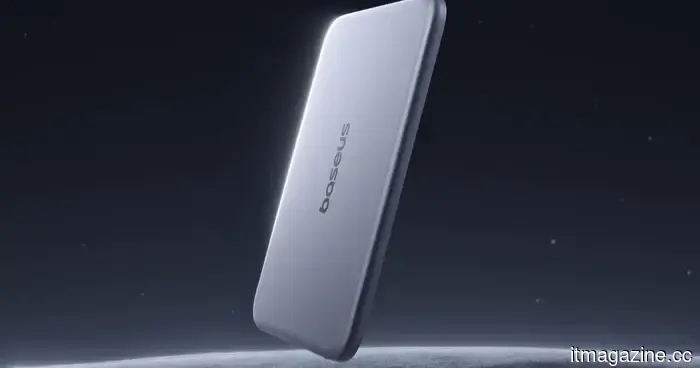 Baseus has introduced an ultra-thin wireless power bank that is expected to arrive in the US shortly.
Baseus has introduced the PicoGo Air in China, a sleek magnetic power bank measuring 6.9mm thick, featuring a capacity of 5,000mAh, offering 15W wireless charging and 22.5W wired charging.
Baseus has introduced an ultra-thin wireless power bank that is expected to arrive in the US shortly.
Baseus has introduced the PicoGo Air in China, a sleek magnetic power bank measuring 6.9mm thick, featuring a capacity of 5,000mAh, offering 15W wireless charging and 22.5W wired charging.
 IBM and Arm have joined forces to operate AI software on mainframes, with no set date announced.
IBM and Arm have revealed a partnership to execute Arm-based AI software on IBM Z mainframes through virtualization. A shipping date has not been provided, as this announcement serves as a roadmap rather than a product release.
IBM and Arm have joined forces to operate AI software on mainframes, with no set date announced.
IBM and Arm have revealed a partnership to execute Arm-based AI software on IBM Z mainframes through virtualization. A shipping date has not been provided, as this announcement serves as a roadmap rather than a product release.
 Which Telegram growth service will be worthwhile in 2026? An explanation of effective growth strategies.
Discover which Telegram growth services are effective in 2026. Investigate intelligent automation, engagement techniques, and hybrid growth methods that expand in a sustainable manner.
Which Telegram growth service will be worthwhile in 2026? An explanation of effective growth strategies.
Discover which Telegram growth services are effective in 2026. Investigate intelligent automation, engagement techniques, and hybrid growth methods that expand in a sustainable manner.
 IBM and Arm have teamed up to operate AI software on mainframes, but a date has not been specified yet.
IBM and Arm have revealed a partnership to operate Arm-based AI software on IBM Z mainframes through virtualization. No specific shipping date has been provided, as this is more of a roadmap than a product announcement.
IBM and Arm have teamed up to operate AI software on mainframes, but a date has not been specified yet.
IBM and Arm have revealed a partnership to operate Arm-based AI software on IBM Z mainframes through virtualization. No specific shipping date has been provided, as this is more of a roadmap than a product announcement.
 Bolt is introducing its Hopp ride-hailing brand to the Canadian corporate travel market.
Hopp for Business has been introduced in 17 municipalities within the Greater Toronto Area, while Bolt expands into corporate accounts one year after its launch for consumers in Toronto.
Bolt is introducing its Hopp ride-hailing brand to the Canadian corporate travel market.
Hopp for Business has been introduced in 17 municipalities within the Greater Toronto Area, while Bolt expands into corporate accounts one year after its launch for consumers in Toronto.
The iPhone 17 Pro Max captures breathtaking images from a lunar mission.
NASA’s Artemis II mission demonstrates the iPhone 17 Pro Max capturing actual images from space, indicating a transition where consumer devices start to enhance traditional cameras in extreme conditions beyond our planet.