
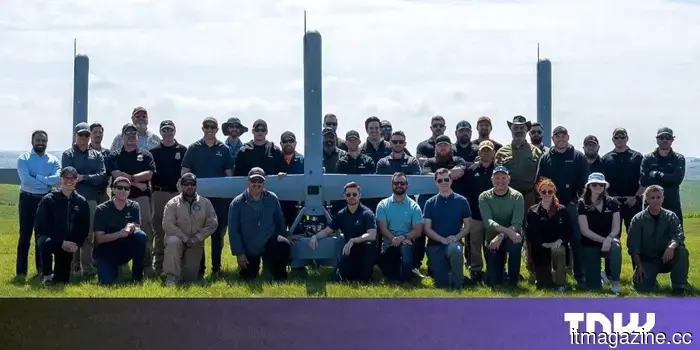
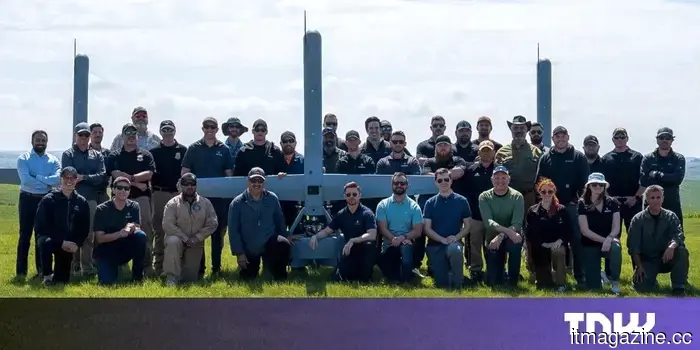
Shield AI secures $2 billion at a valuation of $12.7 billion for its autonomous combat pilot, Hivemind.
Shield AI, a defense technology firm based in San Diego known for its autonomous pilot system Hivemind, announced on Wednesday that it has secured $2 billion in total funding, reaching a valuation of $12.7 billion. Part of this funding will be allocated to acquire Aechelon Technology, which offers a simulation platform supporting the Pentagon's Joint Simulation Environment.
The fundraising consists of two segments: a $1.5 billion Series G led by Advent International and co-led by JPMorgan Chase’s Security and Resiliency Initiative, along with $500 million in preferred equity from Blackstone-managed funds, which also pledged an additional $250 million through a delayed-draw facility. David Mussafer, chairman of Advent, will join Shield AI's board, while Todd Combs from JPMorgan will participate as a board observer.
This valuation marks a significant increase, with Shield AI valued at $5.3 billion as recently as March 2025 when it closed a $240 million F-1 round that included strategic investments from L3Harris and Hanwha Asset Management. Prior to that, it raised $200 million at a valuation of $2.7 billion in October 2023. In just over two and a half years, the company's valuation has skyrocketed nearly five times.
What Hivemind does
Founded in 2015 by brothers Brandon and Ryan Tseng along with Andrew Reiter, Shield AI was conceived to address a specific operational challenge: conducting reconnaissance and strikes in environments where GPS signals are jammed or unavailable and communications are disrupted, conditions classified by the military as DDIL (disconnected, degraded, intermittent, or low-bandwidth).
Hivemind serves as the company's solution, functioning as an AI pilot that allows aircraft to operate autonomously by relying on onboard sensors and reasoning, instead of external navigation signals. In 2018, Shield AI's Nova quadcopter, powered by an early version of Hivemind, became the first autonomous robot of its kind used in combat, deployed with US special operations in the Middle East.
Since then, the technology has been adapted for larger platforms. The V-BAT reconnaissance drone, powered by Hivemind, has completed over 130 sorties in Ukraine since June 2024, operating effectively amid intense electronic warfare conditions. Ukrainian forces utilized the V-BAT to detect a Russian SA-11 Buk-M1 mobile air defense system, successfully navigating without GPS in a heavily jammed environment. Additionally, Hivemind has been tested on modified F-16 fighter jets as part of DARPA’s autonomous dogfighting initiatives and has flown Anduril’s Fury drone, a contender for the US Air Force's next-generation uncrewed combat aircraft.
The X-BAT and the Aechelon acquisition
In October 2025, Shield AI introduced the X-BAT, a VTOL stealth fighter drone that does not require a runway, can be launched from ships, and is fully piloted by Hivemind. The company plans to conduct its first vertical takeoff flight this year, with operational deployment expected by 2028. The X-BAT marks Shield AI's transition from reconnaissance to strike capabilities, significantly broadening its potential market and posing a challenge to larger competitors.
The acquisition of Aechelon aligns with this strategic direction. Aechelon creates high-fidelity simulation environments for the US military and allied forces, facilitating pilot training and autonomous systems testing prior to live flights. Its platform supports the Pentagon's Joint Simulation Environment, which evaluates next-generation aircraft and weapon systems. For Shield AI, integrating Aechelon will provide the synthetic training data necessary for Hivemind to advance across new aircraft types and mission profiles without the expense and risks associated with live flight testing. Shield AI has referred to this integration as a “Hivemind Foundation Model for Defence,” a domain-specific AI model that synthesizes simulation data with real-world operational insights.
The defense technology surge
Shield AI's funding comes in the context of unprecedented capital influx into the defense technology sector. According to PitchBook, venture capital investments in the field reached $49.1 billion in 2025, nearly doubling from the previous year's $27.2 billion. The largest funding rounds have gone to a select few firms developing autonomous and AI-driven military systems. Anduril, Shield AI's closest rival, raised $2.5 billion at a $30.5 billion valuation in June 2025 and was reported in March 2026 to be seeking a $4 billion round at a $60 billion valuation. Helsing, a European defense AI company, has similarly achieved multibillion-dollar valuations.
This surge in spending is attributed to several converging factors: the ongoing war in Ukraine, which has showcased the crucial role of autonomous systems and electronic warfare; escalating tensions in the Pacific, prompting swift procurement of long-range autonomous platforms; and a bipartisan agreement in the US that recognizes the necessity of collaborating with technology
Other articles
 Apple's most affordable iPad may finally improve in terms of performance.
Apple's upcoming budget iPad may receive a significant performance boost with the A18 chip, resulting in enhanced speeds and AI functionalities.
Apple's most affordable iPad may finally improve in terms of performance.
Apple's upcoming budget iPad may receive a significant performance boost with the A18 chip, resulting in enhanced speeds and AI functionalities.
 Samsung introduces its browser to PC, packed with numerous exciting features.
The Samsung Browser has officially launched on Windows, offering cross-device continuity and an AI assistant that provides more than just answers to questions.
Samsung introduces its browser to PC, packed with numerous exciting features.
The Samsung Browser has officially launched on Windows, offering cross-device continuity and an AI assistant that provides more than just answers to questions.
 AI enhances whatever input it receives, including confusion.
AI is not failing because of the technology itself, but because organizations struggle to distinguish meaningful insights from irrelevant information, resulting in unclear data, weak decision-making, and an elusive return on investment.
AI enhances whatever input it receives, including confusion.
AI is not failing because of the technology itself, but because organizations struggle to distinguish meaningful insights from irrelevant information, resulting in unclear data, weak decision-making, and an elusive return on investment.
 Blossom Health secures $20 million to integrate AI copilots with psychiatrists.
Blossom Health, a telepsychiatry startup located in New York and established in 2024, has secured $20 million in total seed and Series A funding to expand its AI-driven platform that connects psychiatrists with clinical copilots and automates administrative tasks.
Blossom Health secures $20 million to integrate AI copilots with psychiatrists.
Blossom Health, a telepsychiatry startup located in New York and established in 2024, has secured $20 million in total seed and Series A funding to expand its AI-driven platform that connects psychiatrists with clinical copilots and automates administrative tasks.
 WYBOT S3: The First Ever Self-Emptying Pool Cleaner Redefines Pool Maintenance from a Chore to a Luxury Experience.
Pool cleaning can be a hassle-free task. With the WYBOT S3, the first self-emptying robotic pool cleaner in the world, you can experience completely hands-free pool maintenance. Merging wireless ease with smart, AI-guided cleaning, it allows you to relax and enjoy your outdoor area without any effort on your part.
WYBOT S3: The First Ever Self-Emptying Pool Cleaner Redefines Pool Maintenance from a Chore to a Luxury Experience.
Pool cleaning can be a hassle-free task. With the WYBOT S3, the first self-emptying robotic pool cleaner in the world, you can experience completely hands-free pool maintenance. Merging wireless ease with smart, AI-guided cleaning, it allows you to relax and enjoy your outdoor area without any effort on your part.
 Why Metro by T-Mobile’s $25 5G Plan Is Difficult to Ignore
Want to lower your phone bill? Look no further. Metro by T-Mobile’s $25 BYOD Single-line plan offers no compromises. Secure this 5-year guaranteed deal and enjoy unlimited data at 5G speed without exceeding your monthly budget.
Why Metro by T-Mobile’s $25 5G Plan Is Difficult to Ignore
Want to lower your phone bill? Look no further. Metro by T-Mobile’s $25 BYOD Single-line plan offers no compromises. Secure this 5-year guaranteed deal and enjoy unlimited data at 5G speed without exceeding your monthly budget.
Shield AI secures $2 billion at a valuation of $12.7 billion for its autonomous combat pilot, Hivemind.
Shield AI secured $2 billion in funding, spearheaded by Advent International, to expand Hivemind, its autonomous pilot with proven combat capabilities, and to purchase the simulation company Aechelon Technology.