
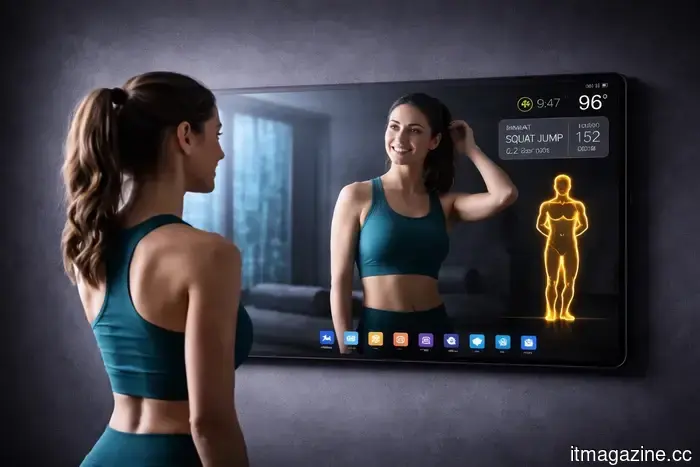
Rapid health assessments lasting 10 seconds and ongoing monitoring for a novel method of individual health management.
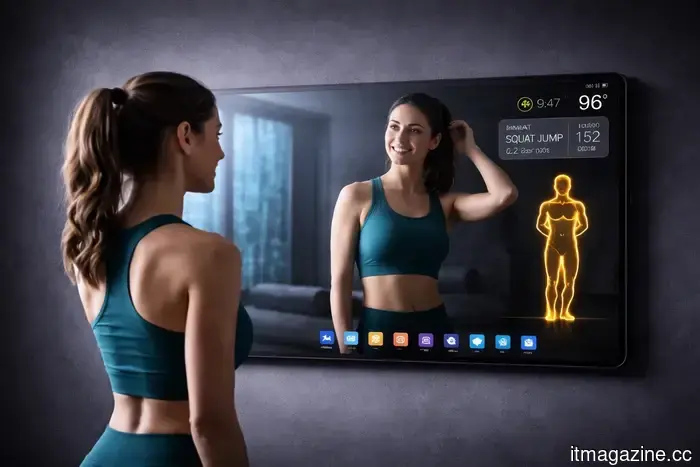
In the near future, individuals will utilize AI-driven devices at home to scan their faces and bodies for health evaluations. Credit: ChatGPT
As technology and healthcare increasingly converge, the Chinese startup Feipu Tech is investigating how non-invasive health assessment technologies can be integrated into daily life. By merging consumer-oriented AI with computational biology models, the company seeks to enhance the speed, accuracy, and accessibility of health monitoring beyond conventional medical environments.
Feipu’s devices are built for ease of use and rapid results. Users can gather and examine multiple crucial health metrics in just seconds, applicable for personal use at home, as well as in workplaces, gyms, and community health stations. This initiative signifies a broader movement towards more convenient and ongoing health management.
Health evaluations become part of everyday life with a 10-second facial scan
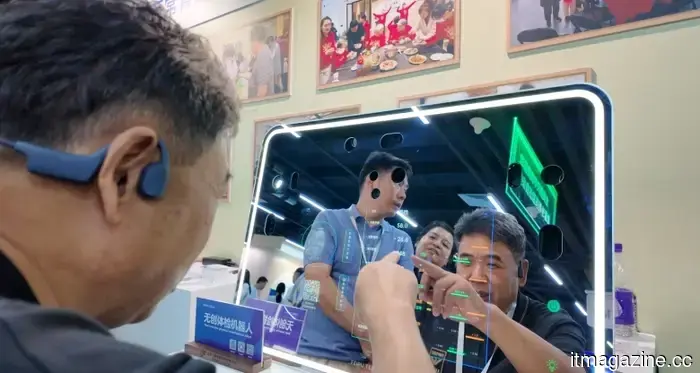
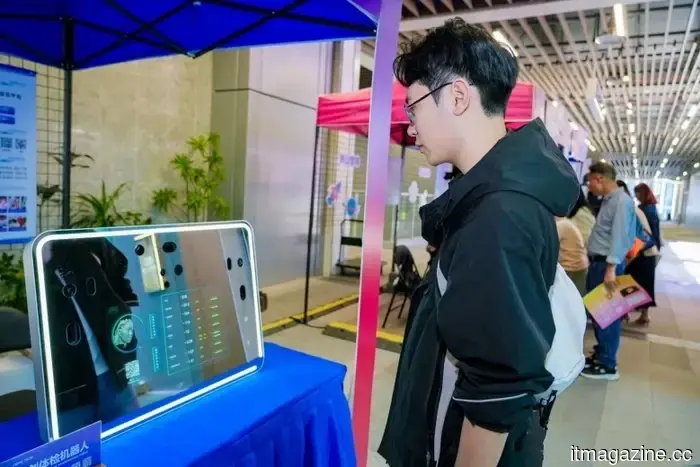
The non-invasive health check robot from Feipu incorporates multiple technologies, including multimodal optical tomography and its proprietary FEIPU MiLC (Multimodal Integrated Language Computing) engine. The device, as stated by the company, can perform non-invasive measurements of essential physiological indicators—like blood pressure, blood glucose, blood lipids, hemoglobin, and BMI—in around 10 seconds.
Designed for straightforward, self-service operation, a user stands naturally in front of the robot, which is approximately the size of a TV screen, aligns their face with the scanning zone, and the system automatically gathers facial and subcutaneous optical signals. The AI engine processes this information in real time, producing a personalized report including key health indicators, risk alerts, and lifestyle suggestions.
The company claims that the data demonstrates an overall accuracy exceeding 85%, with certain indicators (like blood pressure and blood glucose) achieving about 95%, nearing the performance of specific Class II medical devices in China.
In contrast to traditional health examination procedures, this device avoids blood draws or complicated operations. However, its practical effectiveness still needs further validation through independent studies and prolonged data collection.
A health ecosystem spanning homes and communities
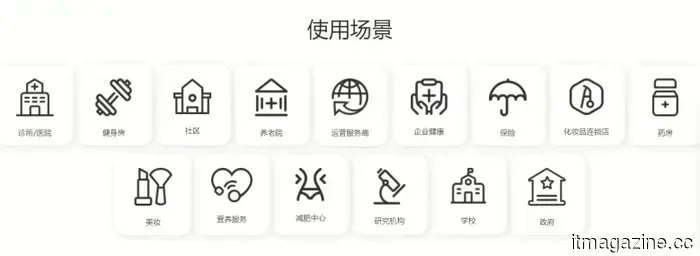
The lightweight design of the Feipu robot, similar in size to a 32-inch TV, makes it ideal for homes, gyms, workplaces, senior care centers, and community health stations.
At home, elderly relatives and children can conduct self-checks, with data synced to the cloud to form ongoing health records. In workplaces, it offers basic health monitoring to track employee well-being and support occupational health management.
In community or public service situations, the device can collaborate with relevant institutions, enabling residents to perform self-service health screenings and contribute data to public health platforms.
Life mirror platform and innovations in health technology
The company has created the Human Life Mirror computing platform, which amalgamates multimodal sensing, deep reinforcement learning, and extensive biological data algorithms. This allows the device to continually enhance its performance using accumulated usage data, resulting in improved detection accuracy over time as the information gathered at the terminal feeds back into the AI model.
Building upon this platform, the company is also investigating applications like early cancer detection, immune system evaluation, and supportive diagnostic robots. It has introduced the first genome-scale SNP analysis model, SNPBag, to aid large-scale biological data analysis and research.
The social impact of simplifying health management
Feipu Tech aims to make health monitoring as effortless as checking the weather. As the founder, Tang Kun, puts it, “We are using technology to empower everyone to become a life scientist.”
Under China's Healthy China initiative, Feipu Tech is utilizing non-invasive health check technology to access the trillion-yuan health management market. The integrated system of “detection, alert, and intervention” serves as a benchmark for industry practices and applies life science research findings in daily settings.
Jessie Wu is a technology reporter based in Shanghai. She covers consumer electronics, semiconductors, and the gaming industry for TechNode. She can be reached via email at: jessie.wu@technode.com.
More by Jessie Wu
Other articles
 Hisense's latest CanvasTV functions as both a television and wall art, and it is set to launch in the US.
Hisense's latest CanvasTV merges an art-frame design with 4K QLED visuals and 144Hz gaming capabilities, and it is now being launched in the US.
Hisense's latest CanvasTV functions as both a television and wall art, and it is set to launch in the US.
Hisense's latest CanvasTV merges an art-frame design with 4K QLED visuals and 144Hz gaming capabilities, and it is now being launched in the US.
 What are the best practices for effectively managing intercompany transactions?
Achieve effective intercompany management with the Intuit Enterprise Suite (IES). This guide outlines straightforward accounting policies, best practices for reconciliation, and necessary system requirements to guarantee precise reporting and consolidation.
What are the best practices for effectively managing intercompany transactions?
Achieve effective intercompany management with the Intuit Enterprise Suite (IES). This guide outlines straightforward accounting policies, best practices for reconciliation, and necessary system requirements to guarantee precise reporting and consolidation.
 This startup is offering $800 per day for you to work as an AI bully.
Memvid's 'AI Bully' position transforms your typical frustrations with chatbots into a paid opportunity, allowing you to challenge AI by pushing chatbots to their limits, revealing how frequently they lose context and make recurring errors.
This startup is offering $800 per day for you to work as an AI bully.
Memvid's 'AI Bully' position transforms your typical frustrations with chatbots into a paid opportunity, allowing you to challenge AI by pushing chatbots to their limits, revealing how frequently they lose context and make recurring errors.
 This incredibly easy solution can reduce the frustration of buffering when streaming videos online.
Rather than freezing to buffer, videos could run at a slightly slower pace without being noticeable, as research indicates that this method provides a smoother and less frustrating experience for the majority of viewers.
This incredibly easy solution can reduce the frustration of buffering when streaming videos online.
Rather than freezing to buffer, videos could run at a slightly slower pace without being noticeable, as research indicates that this method provides a smoother and less frustrating experience for the majority of viewers.
 10-second health assessments and ongoing monitoring for a fresh perspective on personal health.
With the growing intersection of technology and healthcare, the Chinese startup Feipu Tech is investigating how non-invasive health monitoring technologies can be integrated into
10-second health assessments and ongoing monitoring for a fresh perspective on personal health.
With the growing intersection of technology and healthcare, the Chinese startup Feipu Tech is investigating how non-invasive health monitoring technologies can be integrated into
 What are the best practices for managing intercompany transactions efficiently?
Achieve effective intercompany management with the Intuit Enterprise Suite (IES). This guide outlines precise accounting policies, optimal reconciliation practices, and system prerequisites to guarantee accurate reporting and consolidation.
What are the best practices for managing intercompany transactions efficiently?
Achieve effective intercompany management with the Intuit Enterprise Suite (IES). This guide outlines precise accounting policies, optimal reconciliation practices, and system prerequisites to guarantee accurate reporting and consolidation.
Rapid health assessments lasting 10 seconds and ongoing monitoring for a novel method of individual health management.
As technology and healthcare continue to merge, the Chinese startup Feipu Tech is investigating how non-invasive health monitoring technologies can integrate into