
NASA releases breathtaking images of Mars to mark the 20th anniversary of its orbiter.
NASA launched the Mars Reconnaissance Orbiter (MRO) in August 2005, and the following year, on March 10, it successfully entered Mars' orbit, where it continues to function today.
The data sent back to Earth by the MRO has provided an unprecedented view of Mars and has aided scientists in gaining more insight into this intriguing planet over the years.
For instance, during its mission, the MRO discovered evidence suggesting that liquid water may appear seasonally on present-day Mars. Thanks to the orbiter’s highly advanced HiRISE camera, this finding not only unveiled specifics about Mars' geology and climate but also contributed to evaluating the planet’s capability to support microbial life.
This reliable spacecraft also collects information about the planet’s temperatures and mineral composition, and it can even probe beneath the surface using its radar technology.
While its scientific contributions are both significant and thrilling, the orbiter is particularly renowned for the stunning images it captures from its orbit, which ranges from about 155 to 196 miles (250 to 316 km) above the surface.
On its 20th anniversary marked on Tuesday, NASA shared some of those images in a post on X:
"For 20 years, our Mars Reconnaissance Orbiter has searched the planet for signs of ancient water. It has returned photos that are not only breathtaking but also valuable—they will assist us when future astronauts land on Mars to explore. Which one is your favorite?" pic.twitter.com/mc4wHYjqm5— NASA (@NASA) March 10, 2026
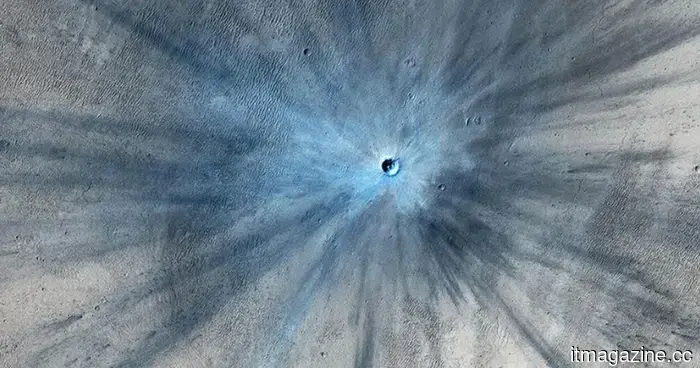
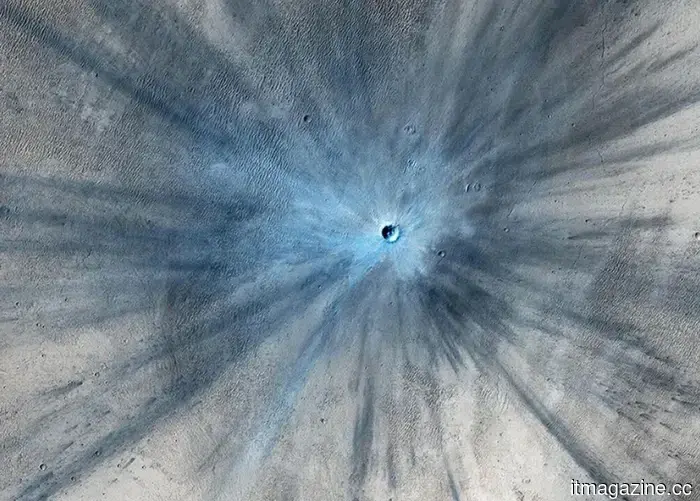
One of the images shows a Martian crater measuring roughly 100 feet (30 meters) in diameter, encircled by a large explosion zone. The blast that formed this crater ejected material as far as 9.3 miles (15 km). Blue tones were added to enhance the details.
NASA/JPL-Caltech/Univ. of Arizona
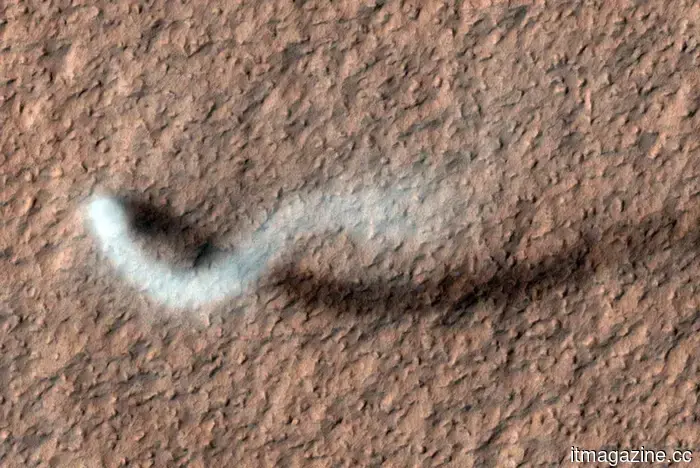
Another image captured by chance depicts a tall dust devil sweeping across the Martian landscape. Taken from an altitude of 185 miles (297 kilometers), the length of the whirlwind's shadow indicates it stood more than half a mile (800 meters) tall, comparable to the height of the Burj Khalifa in the United Arab Emirates, the world’s tallest building.
NASA/JPL-Caltech/Univ. of Arizona
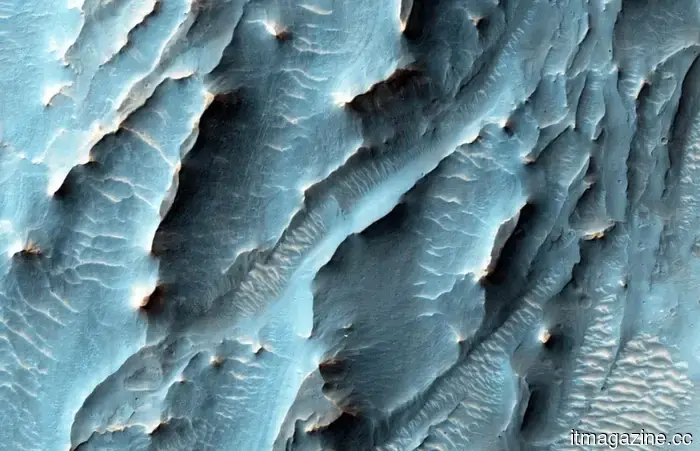
The following image shows an area with unique texture on the floor of Gale Crater, where NASA’s Curiosity rover landed in 2012. Blue tones were added for clarity.
The rover is still operational there today (the MRO has even photographed it!), gradually ascending the base of Mount Sharp (Aeolis Mons), the large mountain at the crater’s center. Notably, the MRO also acts as a crucial communications link, relaying data from the Curiosity and Perseverance rovers back to Earth.
NASA/JPL-Caltech/Univ. of Arizona
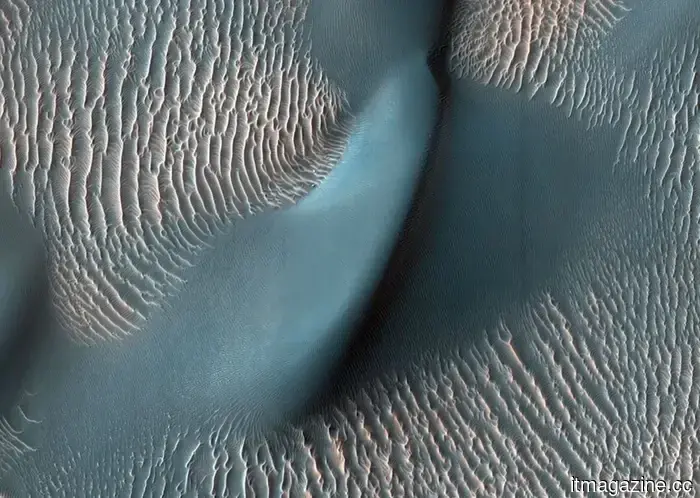
In the image below, blue tones have been added to reveal details such as the tops of dunes and ripples. Much like on Earth, many of these features undergo changes over time, as Martian winds continually shift the sand, altering the landscape.
NASA/JPL-Caltech/Univ. of Arizona
NASA intends to keep the MRO operational for as long as the spacecraft remains in good condition and fuel is sufficient, with plans to continue its mission into the late 2020s, and possibly beyond.
This means we can anticipate many more remarkable images from the experienced Mars orbiter.
Other articles
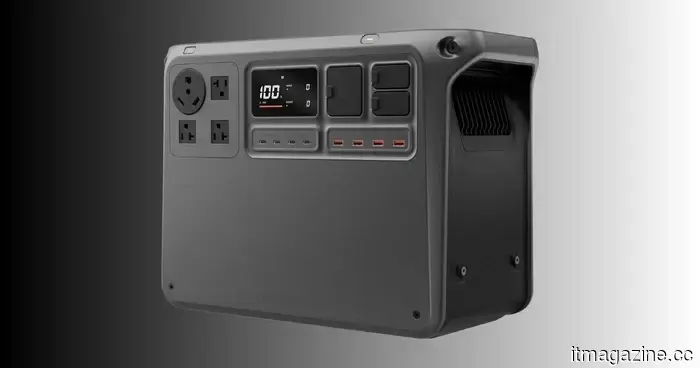 The DJI Power 2000 is priced at $799, positioning it as one of the best value power stations available at the moment.
Portable power stations have seen a surge in popularity recently, yet many of the intriguing options are either too small to be truly functional or priced excessively high. The DJI Power 2000 stands out in a different league: it features a capacity of 2048Wh with LFP technology, offers a continuous output of 3000W, and can recharge from 0 to 80% in just 55 minutes, [...]
The DJI Power 2000 is priced at $799, positioning it as one of the best value power stations available at the moment.
Portable power stations have seen a surge in popularity recently, yet many of the intriguing options are either too small to be truly functional or priced excessively high. The DJI Power 2000 stands out in a different league: it features a capacity of 2048Wh with LFP technology, offers a continuous output of 3000W, and can recharge from 0 to 80% in just 55 minutes, [...]
 Following its focus on gaming and GPUs, Nvidia is setting its sights on the AI agent market to manage your tasks.
Nvidia is set to introduce NemoClaw, an open-source platform designed for AI agents that can operate on any hardware, aimed at enterprise clients with enhanced security functionalities.
Following its focus on gaming and GPUs, Nvidia is setting its sights on the AI agent market to manage your tasks.
Nvidia is set to introduce NemoClaw, an open-source platform designed for AI agents that can operate on any hardware, aimed at enterprise clients with enhanced security functionalities.
 Following games and GPUs, Nvidia's next focus is the AI agent market to manage your tasks.
Nvidia intends to introduce NemoClaw, an open-source platform designed for AI agents that can operate on any hardware, aimed at enterprise clients with enhanced security features.
Following games and GPUs, Nvidia's next focus is the AI agent market to manage your tasks.
Nvidia intends to introduce NemoClaw, an open-source platform designed for AI agents that can operate on any hardware, aimed at enterprise clients with enhanced security features.
 Recognizing the Security Benefits of Major Crypto Exchanges Like OKX
With the global rise in cryptocurrency adoption, the importance of security for crypto exchanges such as OKX has become more critical. For both seasoned users and newcomers in the digital asset space, identifying a secure exchange platform is a primary concern. While each user may have their own favored platform, identifying the safest choice depends on established security criteria. Understanding Previous Threats to Exchange [...]
Recognizing the Security Benefits of Major Crypto Exchanges Like OKX
With the global rise in cryptocurrency adoption, the importance of security for crypto exchanges such as OKX has become more critical. For both seasoned users and newcomers in the digital asset space, identifying a secure exchange platform is a primary concern. While each user may have their own favored platform, identifying the safest choice depends on established security criteria. Understanding Previous Threats to Exchange [...]
 Recognizing the Security Benefits of Top Crypto Exchanges Like OKX
As the global adoption of cryptocurrency expands, the importance of security for crypto exchanges such as OKX becomes more critical. For both seasoned users and those new to the digital asset market, identifying a secure exchange platform is a primary concern. While individual users may have their personal preferences for platforms, establishing the safest choice depends on definitive security criteria. Comprehending Historical Threats to Exchanges [...]
Recognizing the Security Benefits of Top Crypto Exchanges Like OKX
As the global adoption of cryptocurrency expands, the importance of security for crypto exchanges such as OKX becomes more critical. For both seasoned users and those new to the digital asset market, identifying a secure exchange platform is a primary concern. While individual users may have their personal preferences for platforms, establishing the safest choice depends on definitive security criteria. Comprehending Historical Threats to Exchanges [...]
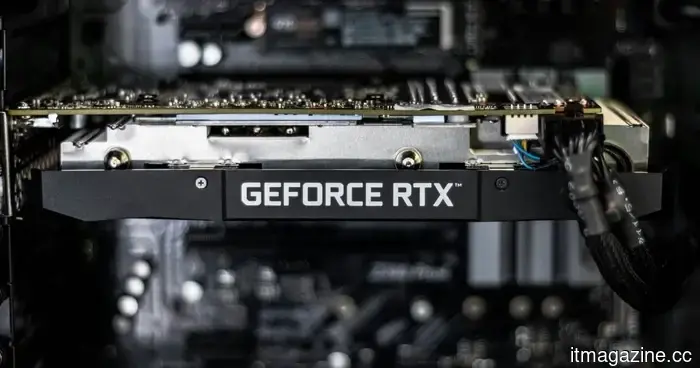 Nvidia leaks suggest that a 9GB version of the GeForce RTX 5050 is imminent.
A recent leak indicates that Nvidia could launch a GeForce RTX 5050 model featuring 9GB of GDDR7 memory, while still keeping the power requirement at 130W.
Nvidia leaks suggest that a 9GB version of the GeForce RTX 5050 is imminent.
A recent leak indicates that Nvidia could launch a GeForce RTX 5050 model featuring 9GB of GDDR7 memory, while still keeping the power requirement at 130W.
NASA releases breathtaking images of Mars to mark the 20th anniversary of its orbiter.
NASA sent the Mars Reconnaissance Orbiter into space in August 2005, and it established orbit around the red planet on March 10 of the following year, where it remains operational. The information transmitted back to Earth by the MRO has provided an unparalleled view of Mars and has assisted scientists over the years in learning more about […]