
Step aside HEPA: NanoJet technology transforms air purification for medical-grade standards.
Air purifiers have not significantly evolved over the years. Most still depend on large HEPA filters, powerful fans, and replaceable cartridges that need to operate continuously to be effective. This model is based on the belief that constant airflow and filtration are the sole means to purify indoor air. But is that truly the case?
Introducing AirSancta®, a company that is innovating air purification with a completely different method: water. Utilizing its proprietary NanoJet® Technology, AirSancta® employs nano droplets of water to encapsulate and eliminate airborne pollutants without the need for filters, chemical additives, or replaceable parts.
It may seem like magic, but it's grounded in science.
The limitations of traditional air purifiers
Traditional air purifiers function as passive systems. They draw air through increasingly dense filters, relying on time, airflow, and pressure to trap contaminants. While effective to a certain extent, this approach has its drawbacks: clogged filters, reduced effectiveness, higher energy consumption, and ongoing replacement expenses.
To remain effective, these systems frequently require continuous operation, using substantial energy while circulating air—along with contaminants—throughout a space before capture. Unless maintenance is performed consistently, filters can become saturated, airflow can diminish, and performance can decline.
AirSancta® recognized this as a design limitation, not merely a need for an upgrade.
Why must air purification necessitate nonstop operation? Why is it essential for every room to have a unit that runs all the time? And why should clean air rely on disposable components?
Re-imagining air purification with water
NanoJet® Technology takes a fundamentally different approach.
Instead of filtering air, AirSancta® releases nano droplets of water in short, controlled bursts. These droplets interact directly with airborne particles, encapsulating pollutants, allergens, odors, and particulate matter, and subsequently removing them from the air as they settle.
The process is active, rapid, and highly efficient.
Due to purification occurring during brief runtime cycles—measured in minutes, not hours—AirSancta® systems do not need to operate continuously. This results in significantly lower energy use compared to traditional filtration-based systems that must run around the clock.
No clogged filters. No airflow reduction. No consumables to maintain. Just clean air delivered through a sleek, water-based method.
Faster action, broader coverage, lower lifetime costs
A key advantage of NanoJet® Technology is its speed. Rather than slowly rotating air through filters, AirSancta® systems can purify a space in quick bursts tailored to room size—allowing one mobile unit to serve multiple rooms as part of a standard cleaning or facility routine.
For homes, this means fewer devices. For offices, clinics, and commercial environments, it translates to lower capital expenditure and dramatically reduced total ownership costs.
With no filters to replace, ongoing costs decline sharply. Without the need for continuous operation, energy consumption is lower. Moreover, since a single unit can be moved between rooms, the necessity for “one purifier per space” diminishes.
AirSancta® systems are designed with practical economics in mind.
Medical-grade air purification without complex infrastructure
Hospitals and cleanrooms have historically depended on complex HVAC systems to ensure air quality—effective but costly, energy-intensive, and impractical outside of regulated settings.
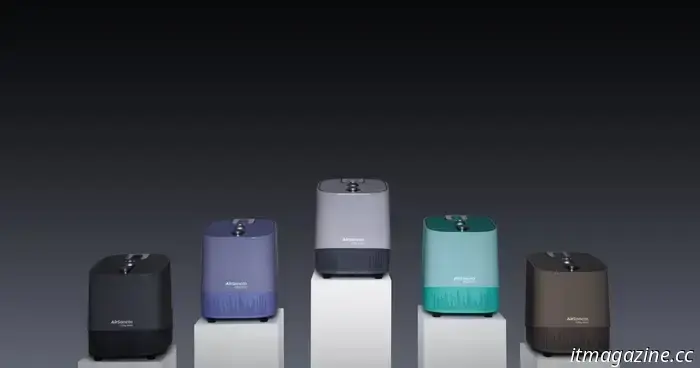
AirSancta® brings principles of medical-grade air purification into compact, mobile systems that are practical for everyday environments. Each model—from the CDa Mini to the CDa Model H and CDa Pro—is driven by the same NanoJet® Technology.
The outcome is a cohesive platform that scales seamlessly from residential areas to professional and healthcare-related environments without requiring specialized infrastructure.
With these benefits, hospitals, clinics, and care facilities are increasingly partnering with AirSancta® to improve indoor air quality in patient rooms, treatment areas, and communal clinical spaces—enhancing air quality without adding to operational complexities.
Designed for consistency and long-lasting protection
Filter-based systems degrade over time. As filters get clogged, performance diminishes—often unnoticed—until maintenance or replacement becomes necessary.
Since AirSancta® does not rely on filters, performance remains stable, with no risk of shutdowns due to saturation. This feature makes it particularly suitable for high-occupancy, shared, or frequently used spaces, where reliability is just as critical as performance.
Short-burst runtimes—potentially as little as one minute per 100 square feet—provide extended protection, as trillions of nano droplets of pure water remain suspended in the air, continuing the purification process for hours following each cycle.
It's air purification designed to align with real life, not against it.
Why this moment is significant
Indoor air quality is more crucial than ever. As buildings become more airtight, urban density rises, and awareness of airborne pollutants increases, the drawbacks of traditional air purification systems are becoming increasingly evident. AirSancta® presents a timely alternative:
Reduced environmental impact with the removal of disposable filters.
Lower lifetime costs through decreased energy consumption and maintenance.

Step aside HEPA: NanoJet technology transforms air purification for medical-grade standards.
Air purifiers have not significantly evolved over the years. The majority still depend on large HEPA filters, powerful fans, and replaceable cartridges that need to operate continuously to work efficiently. This approach is based on the belief that ongoing air circulation and filtration are the sole methods for purifying indoor air. But what if there are other options? Introducing AirSancta®, a company […]