
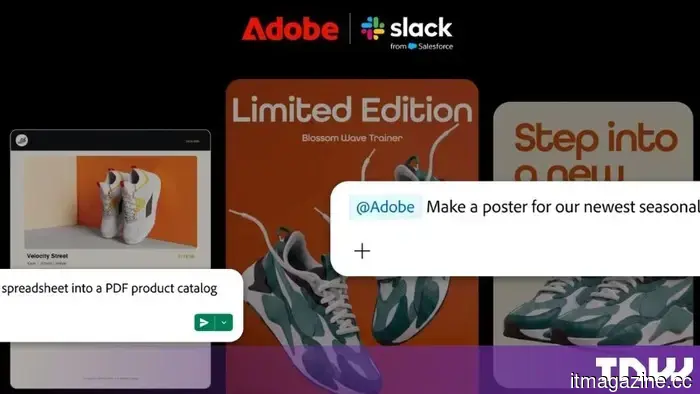
Adobe for Slack converts chat conversations into Firefly-generated images, videos, and PDFs.
Adobe for Slack enables Slackbot to transform conversations and shared files into images, videos, and documents using Firefly, Photoshop, Premiere, Acrobat, and numerous other tools exceeding 70 in total. According to Article 50 of the EU AI Act, synthetic content must now be identified in a machine-readable format, and the Commission references Adobe's C2PA standard as a method for achieving this.
Adobe has integrated its creative software into Slack, allowing Slackbot to send prompts to Firefly, Photoshop, Premiere, or Acrobat, and return the resulting files, as reported by Digital Trends. It analyzes the conversation context to understand user intent and gathers information from discussions, canvases, and shared files. Furthermore, it can search Creative Cloud libraries based on themes, styles, or moods, with connections to over 70 Adobe tools.
This feature is not included in either subscription plan; users must have a Business+ or Enterprise+ Slack account and a separate Adobe subscription. Teams can collaboratively review and improve assets within channels.
This marks the third integration of this nature; Adobe recently created a similar feature for ChatGPT, already has a version for Claude, and has committed to developing one for Gemini.
The European aspect focuses on the outputs generated. Since August 2, 2026, Article 50 mandates that synthetic images, videos, and audio be labeled in a machine-readable format. Adobe is particularly well-positioned for this requirement, having established the Content Authenticity Initiative and co-authored the C2PA standard, which serves as the provenance guideline behind Content Credentials.
Brussels has effectively recognized this standard, with the Commission’s transparency code citing C2PA as an example that meets all four criteria, according to one analysis.
These criteria include robustness, where the marking should endure format conversions and minor edits while being tamper-evident, as much as technically possible. Additionally, it must be interoperable.
This is where a chat client presents an interesting scenario. Manifests can survive conversions executed by C2PA-compatible tools; however, a simple re-save might remove them. It remains unclear whether they retain their integrity through this specific process. Generating in Slack, then downloading and incorporating into a presentation could mean the credential may or may not still be linked.
The code addresses this issue by recommending the use of C2PA in conjunction with an invisible watermark, similar to what OpenAI has implemented alongside Google’s SynthID.
Other solutions are being explored at the output stage. YouTube is now labeling AI-generated videos regardless of creator disclosure, which implies rather than directly marking at the source.
This brings attention to a notable gap. Adobe established the standard while TNW reported that Anthropic is marking everything as the same rules come into play, yet there has been no testing on what happens when using a chat client in this context.
Other articles
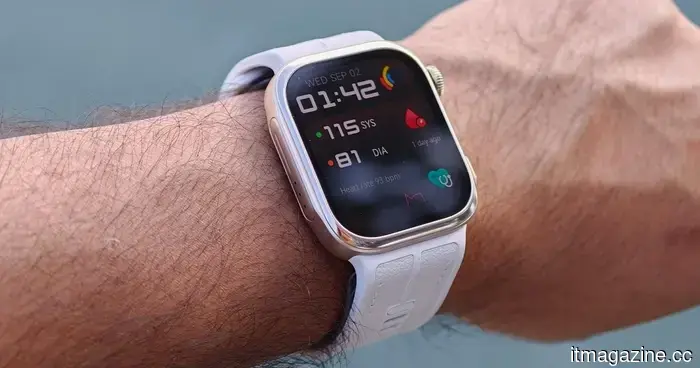 Huawei Watch D3 hands-on: This could be Huawei's most peculiar smartwatch yet, but it may also be its most intelligent.
The Huawei Watch D3 prioritizes blood pressure monitoring as a central feature of the smartwatch. After using it for several days, here are the key highlights.
Huawei Watch D3 hands-on: This could be Huawei's most peculiar smartwatch yet, but it may also be its most intelligent.
The Huawei Watch D3 prioritizes blood pressure monitoring as a central feature of the smartwatch. After using it for several days, here are the key highlights.
 Coder introduces Agent Relay powered by SpaceXAI, utilizing Cursor’s cloud agents on the infrastructure of customers.
Coder's Agent Relay operates Cursor's cloud agents on the customer's infrastructure. Cursor continues to handle the inference, meaning that DORA's responsibilities remain in effect.
Coder introduces Agent Relay powered by SpaceXAI, utilizing Cursor’s cloud agents on the infrastructure of customers.
Coder's Agent Relay operates Cursor's cloud agents on the customer's infrastructure. Cursor continues to handle the inference, meaning that DORA's responsibilities remain in effect.
 World has made ProveKit open-source to enable private ID verification on common smartphones.
World has made ProveKit available as open-source, a zero-knowledge proving toolkit that enables developers to create identity verification processes directly on users' devices. Individuals can demonstrate their age, nationality, or ownership of an ID without disclosing the personal information behind it.
World has made ProveKit open-source to enable private ID verification on common smartphones.
World has made ProveKit available as open-source, a zero-knowledge proving toolkit that enables developers to create identity verification processes directly on users' devices. Individuals can demonstrate their age, nationality, or ownership of an ID without disclosing the personal information behind it.
 The gap in AI skills is widening as educational institutions await ideal solutions.
Teachers who utilize AI on a weekly basis save an average of 5.9 hours each week (Gallup). According to the WEF, 39% of skills might become obsolete by 2030. Kirk Drake contends that schools should cease prohibiting AI and begin educating teachers on how to use it responsibly.
The gap in AI skills is widening as educational institutions await ideal solutions.
Teachers who utilize AI on a weekly basis save an average of 5.9 hours each week (Gallup). According to the WEF, 39% of skills might become obsolete by 2030. Kirk Drake contends that schools should cease prohibiting AI and begin educating teachers on how to use it responsibly.
 Meta's latest AI model is drawing nearer to those developed by OpenAI and Anthropic, according to the company's AI Chief.
Meta has launched Muse Spark 1.3 and has not disclosed whether it will make the weights available. The open-source exemption in the AI Act ends precisely where frontier models begin.
Meta's latest AI model is drawing nearer to those developed by OpenAI and Anthropic, according to the company's AI Chief.
Meta has launched Muse Spark 1.3 and has not disclosed whether it will make the weights available. The open-source exemption in the AI Act ends precisely where frontier models begin.
 ProveKit is now open-sourced by World to enable private identity verification on regular smartphones.
World has released ProveKit as open-source, a zero-knowledge proving toolkit that enables developers to create identity verifications that operate directly on users' devices. Individuals can validate their age, nationality, or possession of identification without disclosing the personal data associated with it.
ProveKit is now open-sourced by World to enable private identity verification on regular smartphones.
World has released ProveKit as open-source, a zero-knowledge proving toolkit that enables developers to create identity verifications that operate directly on users' devices. Individuals can validate their age, nationality, or possession of identification without disclosing the personal data associated with it.
Adobe for Slack converts chat conversations into Firefly-generated images, videos, and PDFs.
Adobe for Slack transforms chat prompts into images and videos using Firefly. EU regulations mandate machine-readable marking, but it remains unclear if it complies.