
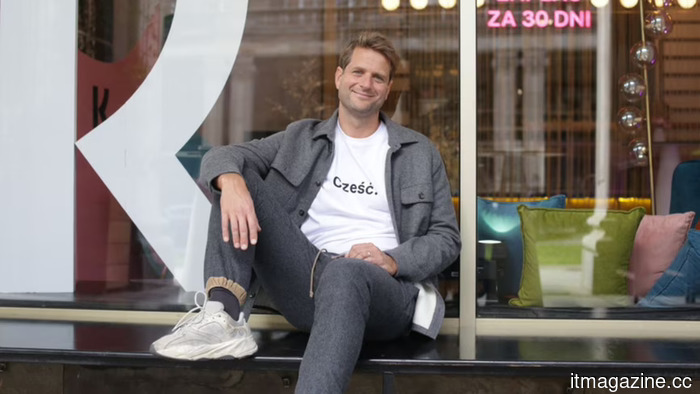
Klarna submits an application for a banking license in the United States.
Klarna aims to establish itself as a genuine American bank. The Swedish BNPL (Buy Now, Pay Later) leader has submitted an application for a US banking license, hoping that a more welcoming Washington will allow it to penetrate a market that has challenged its European competitors.
According to tech.eu, Klarna has sought permission from US regulators to create its own bank. The Swedish fintech has filed with both the Utah Department of Financial Institutions and the Federal Deposit Insurance Corporation (FDIC) to open Klarna Bank USA, which would be an FDIC-insured entity. If granted, Gary Harding, a former chief of Milestone Bank, will manage it, as reported by CNBC.
From BNPL to a full-fledged bank
Klarna currently holds a banking license in Europe, which its CFO has referred to as a significant advantage. In the US, the company has relied on partnerships with other banks. Although it has recently introduced high-yield savings accounts, deposits are still managed by WebBank, not Klarna. A US banking charter could change this arrangement.
By owning a bank, Klarna would be able to fund loans using customer deposits instead of relying on more expensive wholesale funding. This would allow the company to offer checking accounts and credit cards directly, as well as manage payments, lending, and merchant services internally. The goal is to create a more cost-effective and self-sufficient business in the American market.
A competitive search for charters
Klarna is not the only player in this field. Revolut applied for a US banking charter in March, while the Dutch fintech Bunq submitted a new application this year. Meanwhile, Mercury received conditional approval in April. Once regarded as a burden, the pursuit of a banking charter now appears to confer a competitive advantage.
Timing is crucial. The US banking sector has traditionally been resistant to European entrants, and Klarna views the Trump administration as being more open to new players. "Banking is built on trust," stated co-founder and CEO Sebastian Siemiatkowski, who described obtaining their own license as "the natural next step."
Why this is significant
Klarna has expanded significantly in the US, claiming over 30 million customers, a US debit card, and more than $93 billion extended in credit. However, the landscape is not entirely supportive; for instance, Monzo decided to exit the US to refocus on Europe, and Klarna’s shares are currently trading at roughly half their price from the September IPO.
Acquiring a banking license would strengthen Klarna's commitment to the American market at a time when investors are seeking more disciplined approaches. At this point, Klarna has submitted its application, leaving the final decision in the hands of regulators and public trust.
Other articles
 Nintendo has halted the sale of the original Switch in Europe.
Nintendo will cease sales of the original Switch in Europe starting February 2027 to comply with new EU regulations regarding replaceable batteries, which will also influence the design of the Switch 2.
Reddit combats AI-generated marketing spam using its own artificial intelligence.
Brands are exploiting ChatGPT and Gemini by creating fake Reddit posts. Reddit reports that its AI now detects 25,000 spam posts daily. Welcome to GEO.
Nintendo has halted the sale of the original Switch in Europe.
Nintendo will cease sales of the original Switch in Europe starting February 2027 to comply with new EU regulations regarding replaceable batteries, which will also influence the design of the Switch 2.
Reddit combats AI-generated marketing spam using its own artificial intelligence.
Brands are exploiting ChatGPT and Gemini by creating fake Reddit posts. Reddit reports that its AI now detects 25,000 spam posts daily. Welcome to GEO.
 EU called to take action following impact of Pegasus on its spyware investigation.
Campaigners are urging the European Commission to address the spyware crisis in Europe following an incident where a member of the PEGA committee was hacked using Pegasus while looking into the matter.
EU called to take action following impact of Pegasus on its spyware investigation.
Campaigners are urging the European Commission to address the spyware crisis in Europe following an incident where a member of the PEGA committee was hacked using Pegasus while looking into the matter.
 Microsoft lays off 3,200 employees from its Xbox division and sells five studios.
Xbox plans to eliminate approximately 3,200 positions and divest from five studios, including the UK’s Ninja Theory and France’s Arkane, in its largest restructuring to date.
Microsoft lays off 3,200 employees from its Xbox division and sells five studios.
Xbox plans to eliminate approximately 3,200 positions and divest from five studios, including the UK’s Ninja Theory and France’s Arkane, in its largest restructuring to date.
 Broadcom expands its partnership with Apple on chip development until 2031 with a new custom-silicon agreement.
Apple and Broadcom have extended their collaboration until 2031, entering into new agreements to create custom chips for various generations of Apple products.
Broadcom expands its partnership with Apple on chip development until 2031 with a new custom-silicon agreement.
Apple and Broadcom have extended their collaboration until 2031, entering into new agreements to create custom chips for various generations of Apple products.
 EU called on to take action following impact of Pegasus on its spyware investigation.
Activists are urging the European Commission to address Europe's spyware issue after a PEGA committee member was targeted with Pegasus while looking into the matter.
EU called on to take action following impact of Pegasus on its spyware investigation.
Activists are urging the European Commission to address Europe's spyware issue after a PEGA committee member was targeted with Pegasus while looking into the matter.
Klarna submits an application for a banking license in the United States.
Klarna has submitted an application to establish Klarna Bank USA, an FDIC-insured institution in Utah, expanding its offerings beyond buy now, pay later (BNPL) services and competing for a US charter alongside Revolut and Bunq.