
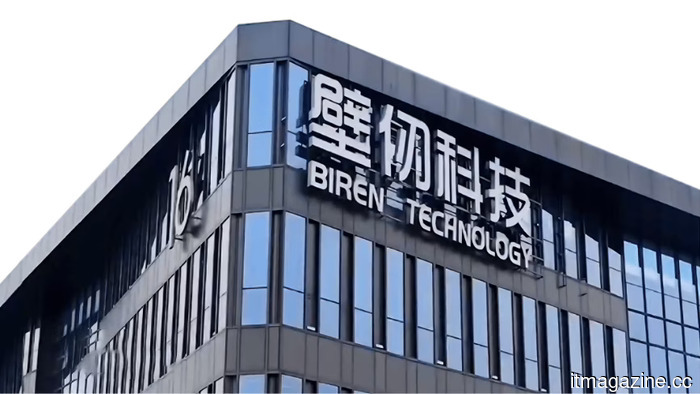
China's Biren secures $892 million to compete with Nvidia.
Nvidia is struggling to sell its top chips in China, leading to a surge of local competitors aiming to fill the void. One such competitor has just secured nearly $900 million to accelerate its efforts.
Shanghai Biren Technology plans to raise HK$7 billion (approximately $892.5 million) through the issuance of new shares to increase GPU production, as reported by the South China Morning Post. This move is based on the belief that buyers in China’s cloud and data center sectors will continue to invest and that Biren can meet their demands.
The Details
Biren will issue 153 million new shares at a price of HK$46.2 each, representing a 9.9 percent discount from Friday’s closing price. The company went public in Hong Kong in January, and its stock has experienced a nearly 150 percent increase since then. However, investor sentiment was more cautious this week, with shares initially rising in early trading but closing 5.4 percent lower on Monday.
A significant portion of the funds has a specific purpose. Biren indicated that 60 percent will be allocated to the commercialization and mass production of its next-generation general-purpose GPUs. An additional 20 percent will go toward research, while the remainder will be used for investments and working capital. This fundraising effort is ambitious, but so is the company's spending, having already utilized over 70 percent of its listing proceeds by the end of June.
The Timing
The situation has been influenced by Washington's export controls that prevent Nvidia’s most advanced AI chips from reaching Chinese customers, creating a lucrative opportunity in the local market. Several domestic firms, including Biren, are racing to seize this chance, competing with companies like Moore Threads, MetaX, and Cambricon for the same customer base.
Demand is not an issue; Biren reported that "customers such as cloud service providers, AI data centers, and enterprise clients are significantly increasing their AI computing deployments." The company presented this fundraising as essential for maintaining momentum, asserting the need for "adequate capital to ramp up production" of its upcoming GPUs to meet order timelines.
A Competitive Landscape
The investment is aimed at a rapidly evolving sector. MetaX, another competitor based in Shanghai, announced its intention to pursue a Hong Kong listing in June, shortly after debuting on the Shanghai STAR Market. Meanwhile, Kunlunxin, Baidu's chip division, is reportedly aiming for an even higher valuation, seeking at least 100 billion yuan (around $14.7 billion) for its Hong Kong offering.
Despite these efforts, Biren is not on the same level as Nvidia. Its chips still lag behind the industry leader, and China’s most advanced AI accelerators are primarily custom designs from companies like Huawei, rather than general-purpose GPUs.
Nonetheless, with foreign supply restricted, the demand for “good enough” chips produced in China represents a viable business opportunity, justifying the nearly $900 million in new capital. The market gap created by Nvidia's absence is the entire potential this presents.
Other articles
 Is the ‘SaaSpocalypse’ just a myth? The actual expenses of AI-generated software.
AI has greatly simplified and reduced the cost of developing software in-house, leading many executives to re-evaluate SaaS subscriptions primarily from a cost-reduction perspective.
Is the ‘SaaSpocalypse’ just a myth? The actual expenses of AI-generated software.
AI has greatly simplified and reduced the cost of developing software in-house, leading many executives to re-evaluate SaaS subscriptions primarily from a cost-reduction perspective.
 Samsung is on track for an 18-fold increase in profits due to a surge in demand for AI memory.
Analysts predict that Samsung will announce an operating profit of approximately 86 trillion won for Q2, which is about 18 times higher than last year, due to a rise in AI memory prices.
Samsung is on track for an 18-fold increase in profits due to a surge in demand for AI memory.
Analysts predict that Samsung will announce an operating profit of approximately 86 trillion won for Q2, which is about 18 times higher than last year, due to a rise in AI memory prices.
 Samsung’s appliance employees intend to hold a rally regarding the bonuses awarded to chip division workers.
Samsung employees involved in the production of phones, TVs, and appliances will protest in Suwon regarding a bonus arrangement that awards chip workers up to 600 million won, while they are set to receive only 6 million won.
Samsung’s appliance employees intend to hold a rally regarding the bonuses awarded to chip division workers.
Samsung employees involved in the production of phones, TVs, and appliances will protest in Suwon regarding a bonus arrangement that awards chip workers up to 600 million won, while they are set to receive only 6 million won.
 The Washington Post forecasted technological advancements 50 years ago, and the accuracy of those predictions is quite humbling.
The Washington Post revisited a 1976 article that predicted life in 2026, highlighting the accuracy of its forecasts concerning smartphones, solar energy, gene editing, and various other technological advancements.
The Washington Post forecasted technological advancements 50 years ago, and the accuracy of those predictions is quite humbling.
The Washington Post revisited a 1976 article that predicted life in 2026, highlighting the accuracy of its forecasts concerning smartphones, solar energy, gene editing, and various other technological advancements.
 The energy consumption of AI was already troubling. Studies indicate that AI agents are over a hundred times more energy-intensive.
A study conducted by KAIST indicates that AI agents use significantly more energy compared to traditional AI, underscoring an increasing issue for data centers and the future of AI infrastructure.
The energy consumption of AI was already troubling. Studies indicate that AI agents are over a hundred times more energy-intensive.
A study conducted by KAIST indicates that AI agents use significantly more energy compared to traditional AI, underscoring an increasing issue for data centers and the future of AI infrastructure.
 Shampoo and cookies receive an AI upgrade as major consumer brands revamp their laboratories.
P&G, Unilever, and Mondelez are utilizing AI to develop products and execute campaigns, shortening timelines that previously required years to just weeks.
Shampoo and cookies receive an AI upgrade as major consumer brands revamp their laboratories.
P&G, Unilever, and Mondelez are utilizing AI to develop products and execute campaigns, shortening timelines that previously required years to just weeks.
China's Biren secures $892 million to compete with Nvidia.
Shanghai Biren is offering HK$7 billion (approximately $892 million) in new shares to facilitate the mass production of its upcoming GPUs, as US restrictions on Nvidia present an opportunity for China's chip manufacturers.