
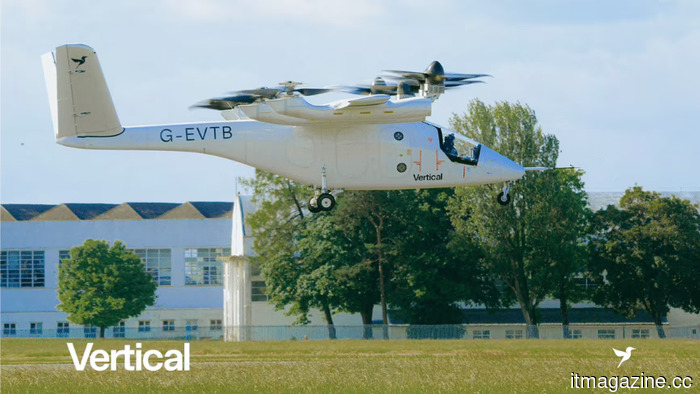
Vertical Aerospace has conducted a flight with a second prototype of the VX4.
Creating an electric air taxi is less about making a spectacular first flight and more about consistently achieving flights until regulators are satisfied. Vertical Aerospace has just launched its second aircraft to expedite this process.
The company based in Bristol announced on Tuesday that its latest full-scale prototype successfully completed its inaugural piloted flight at its flight test center in the UK, with test pilot Paul Stone at the controls at 8:49 BST on June 5.
This flight followed the issuance of a new Permit to Fly by the UK Civil Aviation Authority, granted after thorough ground testing. This new prototype essentially doubles Vertical’s testing capacity while the first prototype continues its flight testing.
This is not Vertical’s first foray into the air. The company conducted its first untethered test flight in 2023, made European history with a piloted wingborne flight last year, and executed a complete two-way transition between vertical and horizontal flight in April, joining a select group of developers who have accomplished that feat.
The aim of the new jet is to increase output. Two aircraft operating simultaneously generate data more rapidly, and this will be the last prototype introduced before the Critical Design Review, a key milestone that finalizes a certifiable design and paves the way for constructing the initial pre-production aircraft.
"Getting our latest prototype into the flight-testing phase is a significant milestone because it enables us to learn more rapidly in real-world conditions and maintain momentum towards certification," stated Stuart Simpson, CEO of Vertical Aerospace. "Expanding the flight test fleet will facilitate quicker validation of the aircraft, mitigate risk, and enhance efficiency in progressing toward bringing Valo into service."
Once the aircraft has completed all testing phases in its all-electric configuration, Vertical intends to modify it for hybrid-electric flight. This variant is designed for the longer ranges and greater payloads sought by defense and logistics clients, providing a backup beyond the four-passenger Valo air taxi that the company is certifying first.
Vertical claims to have about 1,500 pre-orders for the Valo from customers like American Airlines, Japan Airlines, Avolon, Bristow, and Brazil’s GOL, although, as is common in this industry, these represent conditional commitments rather than confirmed cash.
The landscape is challenging. Vertical is in competition with American rivals Joby and Archer, who have made further progress in U.S. certification, and the broader sector has seen significant turmoil: at least six eVTOL manufacturers, including previously celebrated names like Lilium and Volocopter, have gone bankrupt since 2023 due to the expenses and complexities of aircraft certification.
Vertical has also faced its own difficulties, pushing back its CAA certification target to the end of 2026, about two years later than initially planned, and dealing with a patent lawsuit from Archer earlier this year.
The second prototype offers Vertical a chance to increase its pace. More aircraft lead to more flight hours, quicker validation, and a credible pathway toward the design review that transforms a test program into a certifiable product. The bigger challenges, such as securing funding for commercial operations and navigating a constantly shifting regulatory environment, are issues the entire sector continues to grapple with.
However, adding a functioning aircraft to the fleet, along with the associated public demonstrations, represents the kind of consistent progress that helps an eVTOL company stay competitive rather than fall behind.
Other articles
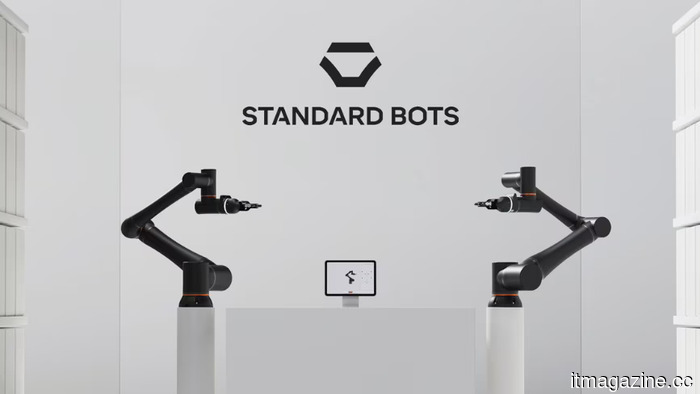 Standard Bots achieves a $1 billion valuation following a $200 million fundraising round for robotics.
US robotic arm manufacturer Standard Bots secured $200 million at a valuation of $1 billion, with General Catalyst leading the investment, to expand its Long Island factory as the US seeks to compete with China.
Standard Bots achieves a $1 billion valuation following a $200 million fundraising round for robotics.
US robotic arm manufacturer Standard Bots secured $200 million at a valuation of $1 billion, with General Catalyst leading the investment, to expand its Long Island factory as the US seeks to compete with China.
.jpg) 9 top HRIS solutions for large enterprises (2026)
Enterprise HRIS platforms assessed based on total cost of ownership, deployment schedules, global preparedness, and their alignment with the dynamics of a distributed workforce in 2026. Slug: best-hris-systems-large-organizations-2026
9 top HRIS solutions for large enterprises (2026)
Enterprise HRIS platforms assessed based on total cost of ownership, deployment schedules, global preparedness, and their alignment with the dynamics of a distributed workforce in 2026. Slug: best-hris-systems-large-organizations-2026
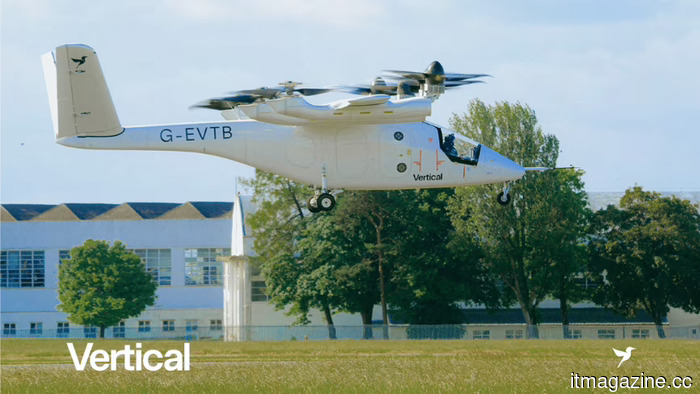 Vertical Aerospace has completed a second flight with its VX4 prototype.
The last VX4 prototype from Vertical Aerospace completed its first piloted flight on June 5, increasing testing capabilities ahead of the Critical Design Review for its Valo air taxi.
Vertical Aerospace has completed a second flight with its VX4 prototype.
The last VX4 prototype from Vertical Aerospace completed its first piloted flight on June 5, increasing testing capabilities ahead of the Critical Design Review for its Valo air taxi.
 France's official messaging service Tchap suffers from an account breach.
France's government messaging platform Tchap was compromised through a stolen account. Authorities state that only public channels were affected, while a hacker alleges that 73,000 accounts were involved.
France's official messaging service Tchap suffers from an account breach.
France's government messaging platform Tchap was compromised through a stolen account. Authorities state that only public channels were affected, while a hacker alleges that 73,000 accounts were involved.
 NinjaOne's valuation increases to $12.3 billion in a secondary funding round.
Austin-based IT operations company NinjaOne more than doubled its valuation to $12.3 billion in a secondary round exceeding $400 million, enhancing its cap table in anticipation of a potential IPO.
NinjaOne's valuation increases to $12.3 billion in a secondary funding round.
Austin-based IT operations company NinjaOne more than doubled its valuation to $12.3 billion in a secondary round exceeding $400 million, enhancing its cap table in anticipation of a potential IPO.
Vertical Aerospace has conducted a flight with a second prototype of the VX4.
Vertical Aerospace's last VX4 prototype completed its first piloted flight on 5 June, effectively doubling testing capabilities prior to the Critical Design Review for its Valo air taxi.