
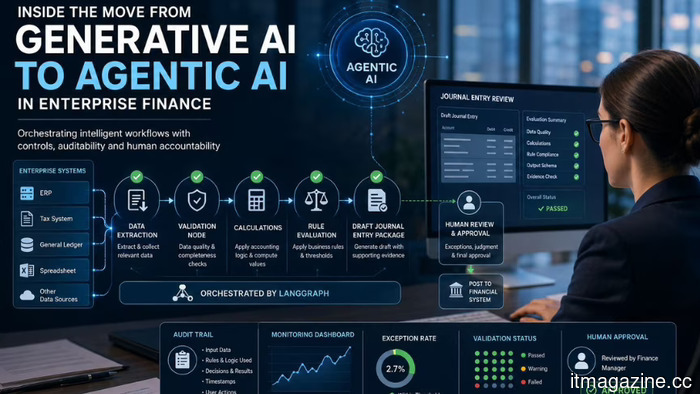
The transition from generative AI to agentic AI in corporate finance.
TL;DR
AT&T's finance team is developing agentic AI workflows utilizing LangGraph to streamline the manual preparation of journal entries under SOX regulations. This architecture distinguishes between repetitive tasks and human judgment through finance-managed playbooks, node-level auditing evidence, and defined approval processes.
Generative AI has already transformed the way companies draft, summarize, and search for information. The upcoming challenge is more intricate: whether AI can manage tasks across business systems while ensuring controls, auditability, and human responsibility.
This is the core evaluation for agentic AI. Unlike traditional chatbots that merely provide answers, an agentic system can understand objectives, retrieve data, utilize tools, apply rules, verify results, and prepare work for human assessment. In regulated sectors like finance, this functionality presents both opportunities and risks. An effective system must not only automate tasks but also demonstrate what data was utilized, the decision-making logic applied, where exceptions arose, and who authorized the final action.
Manual journal entries serve as a practical illustration. In large financial organizations, these entries usually necessitate analysts to pull information from various systems, reconcile inputs, apply accounting principles, calculate values, prepare supporting documentation, and forward the package for approval. This process is repetitive, time-sensitive, and heavily regulated, especially since journal entries influence financial reports and function within SOX-compliant environments.
At AT&T, Monika Malik, a Lead Data and AI Engineer in finance, has been addressing this issue through the Manual Journal Entry initiative, which uses an agentic approach. The design does not allow an AI model to independently post entries but instead differentiates between repetitive preparatory tasks and professional judgment required for final approval.
The finance environment's scale is considerable, with tax and accounting workflows linked to a broader modernization initiative that involves hundreds of millions of dollars in accrued liabilities and ongoing business value.
The workflow employs LangGraph as the orchestrating framework, which is significant because a graph-based structure allows the finance process to be depicted as a series of explicit nodes, branches, and checkpoints rather than a single, unclear automation. In a SOX-regulated process, this configuration is advantageous as each step can be individually audited. Conditional branches can correspond to actual financial approval pathways: a straightforward entry can proceed, while entries with threshold breaches, missing documentation, or rule exceptions can be flagged for review.
In this framework, one node might manage data extraction, another might convert source data, yet another might compute journal values, and another might create a draft template. Each node generates a structured, timestamped output that logs the input data, the decision or rule applied, and the validation result, creating an audit trail that can be reviewed later, rather than depending on a final output lacking transparency in its production process.
Another vital design element is the incorporation of finance-owned playbooks. Rather than hardcoding every rule into technical logic, finance subject-matter experts define and maintain the business processes. These playbooks outline the required execution steps, tools to be used, thresholds to apply, necessary evidence, and standards for what constitutes a “good” journal entry. Engineering manages the orchestration and execution layer, while finance maintains the business logic. This division ensures process accountability remains with the business while enabling the workflow to scale across various entry types.
The system also incorporates node-level evaluations as control checks. Practically, this means that every stage of the workflow can be verified before the next one is initiated. Data-quality checks can ensure that all required fields are filled, calculation checks can re-evaluate totals and verify sign conventions or balancing rules, output-schema checks can affirm the completeness of the journal-entry template, and rule-based checks can compare values to thresholds or expectations from previous periods. LLM-based evaluations can flag unsupported explanations, such as narratives referencing data not present in the workflow.
Monitoring is another integral aspect of the architecture. A model-monitoring layer assesses whether the system continues to function within defined boundaries over time, focusing on output drift, exception rates, repeated validation failures, and changes in pass/fail trends. The objective is to identify not only potential model quality issues but also to ensure the workflow remains reliable enough for controlled finance processes.
The human-in-the-loop boundary is clearly defined. The system prepares a validated package that includes the draft output, evaluation results, exception notes, retry history, and supporting documentation. Human reviewers retain responsibility for exceptions, professional judgment, and final approval. While the workflow enhances consistency and timeliness, it does not eliminate accountability within the finance function.
Malik’s background in regulated banking also influences this strategy, particularly in emphasizing data quality, traceability, and operational reliability.
The example of Manual Journal Entry illustrates a more specific enterprise pattern: agentic AI in finance becomes effective only when orchestration, business-managed rules, node-level evidence, monitoring, and approval boundaries are designed collaboratively. LangGraph offers the workflow structure, finance-owned playbooks maintain business control, node-level evaluations generate audit evidence, monitoring ensures behavior stays within limits, and human reviewers are
Other articles
 Orbital secures $5 million to develop AI data centers in space.
Orbital, backed by a16z speedrun, has secured $5 million in pre-seed funding to develop solar-powered AI data centers in low Earth orbit, with a demonstration flight by SpaceX scheduled for 2027.
Orbital secures $5 million to develop AI data centers in space.
Orbital, backed by a16z speedrun, has secured $5 million in pre-seed funding to develop solar-powered AI data centers in low Earth orbit, with a demonstration flight by SpaceX scheduled for 2027.
 Thoma Bravo claims that the 'SaaSpocalypse' has come to an end.
Orlando Bravo of Thoma Bravo states that the 'SaaSpocalypse' has ended and that AI is providing a boost for software. However, the recovery is inconsistent, and the expenses associated with AI agents are increasing.
Thoma Bravo claims that the 'SaaSpocalypse' has come to an end.
Orlando Bravo of Thoma Bravo states that the 'SaaSpocalypse' has ended and that AI is providing a boost for software. However, the recovery is inconsistent, and the expenses associated with AI agents are increasing.
 Beacon secures $225 million for its 'anti-PE' AI consolidation.
Beacon secured $225 million in a Series C funding round led by General Catalyst to purchase 'Main Street' software companies and enhance them with AI, now acquiring approximately one each week.
Beacon secures $225 million for its 'anti-PE' AI consolidation.
Beacon secured $225 million in a Series C funding round led by General Catalyst to purchase 'Main Street' software companies and enhance them with AI, now acquiring approximately one each week.
 Microsoft reduces hundreds of Azure cloud positions in China.
Microsoft is eliminating 200-400 Azure positions in Beijing and Shanghai, marking its third reduction in China within two years, as the United States and China impose stricter cross-border data regulations.
Microsoft reduces hundreds of Azure cloud positions in China.
Microsoft is eliminating 200-400 Azure positions in Beijing and Shanghai, marking its third reduction in China within two years, as the United States and China impose stricter cross-border data regulations.
 Klarna introduces US savings accounts with a 3.28% interest rate through WebBank.
Klarna introduces its high-yield savings account in the US with a 3.28% APY, offered through the FDIC-insured WebBank. This rate is lower than those of Marcus (3.4%) and SoFi (3.8%). Specifics regarding deposits have not been revealed.
Klarna introduces US savings accounts with a 3.28% interest rate through WebBank.
Klarna introduces its high-yield savings account in the US with a 3.28% APY, offered through the FDIC-insured WebBank. This rate is lower than those of Marcus (3.4%) and SoFi (3.8%). Specifics regarding deposits have not been revealed.
 Safari is finally addressing its extensions issue. Unlike Chrome, Apple will allow you to develop your own extensions.
Safari is introducing an AI-driven extension builder that enables users to articulate the browser tool they desire. This could assist Apple in addressing one of Safari's long-standing shortcomings without competing against Chrome's extensive add-on collection.
Safari is finally addressing its extensions issue. Unlike Chrome, Apple will allow you to develop your own extensions.
Safari is introducing an AI-driven extension builder that enables users to articulate the browser tool they desire. This could assist Apple in addressing one of Safari's long-standing shortcomings without competing against Chrome's extensive add-on collection.
The transition from generative AI to agentic AI in corporate finance.
The finance department at AT&T is utilizing LangGraph-driven agentic workflows to streamline the preparation of journal entries in accordance with SOX regulations. This includes finance-managed playbooks, audit trails at the node level, and clearly defined boundaries for human approval.