
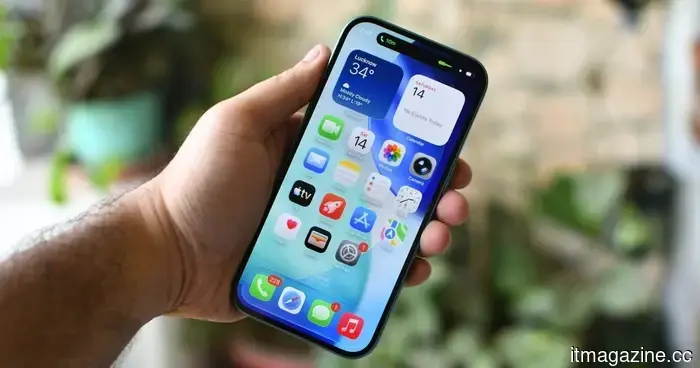
Smartphones are being held responsible for decreasing birth rates, with research emphasizing the influence of the iPhone.
Two recent studies associate the rise of smartphone usage with declining birth rates in the US and 128 other countries, although some economists argue that this connection is not yet substantiated.
The coincidence of timing has prompted scrutiny. In 2007, when Apple launched the first iPhone, birth rates in the US and several other nations began to decrease. Two new academic studies, featured in The New York Times, suggest that this correlation might not be mere chance.
Research Findings
Economist Caitlin Myers and her student Ezekiel Hooper from Middlebury College based their research on a unique circumstance: the original iPhone was only compatible with AT&T’s network. This provided them a natural experiment. Counties with robust AT&T service gained early access to smartphones, while those lacking it did not.
By analyzing fertility data between these two demographics, the researchers inferred that access to the iPhone accounted for up to half of the decline in the US birth rate from 2007 to 2011, especially among individuals aged 15 to 24. They highlighted a reduction in in-person social interactions, increased access to pornography, and improved knowledge regarding contraception and abortion as potential reasons for the decline.
A broader investigation was conducted by Hernan Moscoso Boedo, an economics professor at the University of Cincinnati, and PhD student Nathan Hudson. They analyzed World Bank data spanning 128 nations and observed a significant drop in teenage fertility rates after smartphones became prevalent, regardless of healthcare systems, religious beliefs, or economic statuses. They noted that in the US, areas with faster broadband and 4G coverage experienced more pronounced declines in teenage birth rates.
A Debated Conclusion
The research does not resolve the ongoing discussion. Economist Theodore Joyce from Baruch College notes that teen birth rates were already decreasing before 2007, suggesting that while the smartphone theory is plausible, it lacks conclusive proof.
This research emerges as governments in the US, Europe, and East Asia confront the long-term economic challenges posed by declining populations. If smartphones are indeed a significant factor, this complicates potential policy measures since, unlike economic recessions or housing prices, regulating screen time is not straightforward for lawmakers.




Other articles
 As Apple advances its software with AI, the RAM shortage has caught up, leaving your devices feeling outdated.
Apple's iOS 27 AI requirements indicate that RAM is increasingly becoming the new barrier for upgrades. While devices with 8GB of RAM are still supported, they are not as equipped to handle Apple's most advanced on-device AI functionalities.
As Apple advances its software with AI, the RAM shortage has caught up, leaving your devices feeling outdated.
Apple's iOS 27 AI requirements indicate that RAM is increasingly becoming the new barrier for upgrades. While devices with 8GB of RAM are still supported, they are not as equipped to handle Apple's most advanced on-device AI functionalities.
 Google AI Plus now costs $4.99 per month and offers double the storage.
Google is reducing the price of its AI Plus subscription from $7.99 to $4.99 per month and increasing cloud storage from 200GB to 400GB.
Google AI Plus now costs $4.99 per month and offers double the storage.
Google is reducing the price of its AI Plus subscription from $7.99 to $4.99 per month and increasing cloud storage from 200GB to 400GB.
 Standard Bots reaches a $1 billion valuation following a $200 million funding round in robotics.
US robot-arm manufacturer Standard Bots secured $200 million at a valuation of $1 billion, with General Catalyst leading the investment, to expand its Long Island facility as the US aims to compete with China.
Standard Bots reaches a $1 billion valuation following a $200 million funding round in robotics.
US robot-arm manufacturer Standard Bots secured $200 million at a valuation of $1 billion, with General Catalyst leading the investment, to expand its Long Island facility as the US aims to compete with China.
 Google AI Plus is now available for $4.99 per month and offers double the storage.
Google is reducing the price of its AI Plus subscription from $7.99 to $4.99 per month and increasing the cloud storage from 200GB to 400GB.
Google AI Plus is now available for $4.99 per month and offers double the storage.
Google is reducing the price of its AI Plus subscription from $7.99 to $4.99 per month and increasing the cloud storage from 200GB to 400GB.
 The film organization in the UK is preserving internet memes and viral videos. Among them is "Charlie bit my finger."
The British Film Institute is conserving 430 viral videos and memes, such as Charlie bit my finger, Badgers, and the livestream featuring Liz Truss and a lettuce.
The film organization in the UK is preserving internet memes and viral videos. Among them is "Charlie bit my finger."
The British Film Institute is conserving 430 viral videos and memes, such as Charlie bit my finger, Badgers, and the livestream featuring Liz Truss and a lettuce.
 As Apple advances AI in its software, the RAM crisis has caught up, making your devices seem outdated.
According to Apple’s iOS 27 AI requirements, RAM appears to be the new barrier for upgrades. While devices with 8GB of RAM are still supported, they are not as equipped to handle Apple's most advanced on-device AI functionalities.
As Apple advances AI in its software, the RAM crisis has caught up, making your devices seem outdated.
According to Apple’s iOS 27 AI requirements, RAM appears to be the new barrier for upgrades. While devices with 8GB of RAM are still supported, they are not as equipped to handle Apple's most advanced on-device AI functionalities.
Smartphones are being held responsible for decreasing birth rates, with research emphasizing the influence of the iPhone.
Two recent studies suggest that the introduction of smartphones, starting with the launch of the iPhone in 2007, has played a major role in the decline of birth rates both in the US and around the world.