
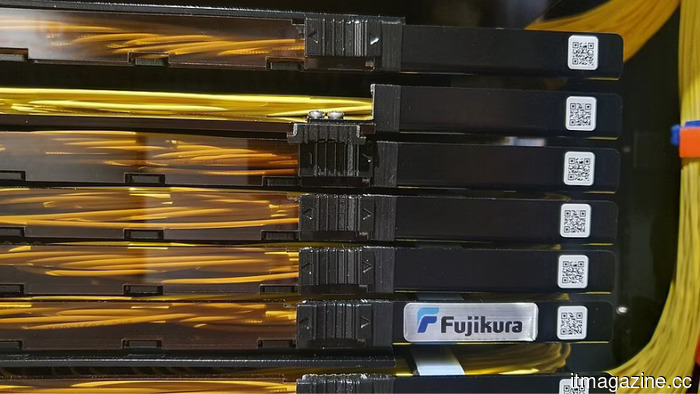
Fujikura increases prices for AI data center cables due to tightening supply.
**TL;DR** Fujikura is increasing prices for its fibre-optic cables as nearly all US hyperscalers are placing orders amid tight supply. The CEO claims the company will surpass its forecasts, even though shares have dropped 40% since their peak in May.
Fujikura, the Tokyo-based manufacturer of fibre-optic cables, is raising the prices of the cables that connect servers within AI data centres. CEO Naoki Okada informed Bloomberg that the company is poised to exceed its own projections due to consistent demand from nearly all leading US hyperscalers. "We supply a valuable product," stated Okada. "We will increase prices further."
**Cables as a Bottleneck**
AI data centres require significantly more fibre-optic cables than typical cloud facilities. These small glass strands transmit data through light pulses between GPUs, and the large volume of data generated by AI training and inference has made cabling a limiting factor for the speed at which new clusters can be established.
Fujikura, alongside Japan’s Sumitomo Electric and Furukawa Electric, leads the high-end market segment. The current supply constraints have granted them pricing power that is rare among component suppliers in the AI sector.
**The Meta and Nvidia Signal**
US competitor Corning has secured a $6 billion supply agreement with Meta and a separate $500 million stock deal with Nvidia. Both contracts, revealed in recent months, indicate that hyperscalers regard fibre-optic supply as so essential that they are willing to secure long-term capacity at premium prices.
Okada noted that Fujikura is receiving orders from nearly all US hyperscalers. Some clients have already consented to higher prices for the company's main products, though Okada did not specify which clients or the extent of the price increases.
**The Stock Decline**
Fujikura’s shares have fallen over 40% from a peak reached in May. This drop was prompted by annual and three-year profit forecasts that significantly underperformed analyst predictions, raising worries about production capacity constraints, increasing competition, and supply chain issues. Okada described the forecast as intentionally conservative, taking into account worst-case scenarios, including the potential for hydrogen shortages required in the manufacturing of fibre-optic preforms, the glass rods used for cables. "There is no way we will miss our annual forecast," he affirmed.
**The Quiet Winners of the AI Infrastructure Supply Chain**
The most prominent beneficiaries of the AI expansion are chipmakers like Nvidia and memory manufacturers like SK Hynix. However, the physical infrastructure—cables, connectors, cooling systems, and power distribution—represents where many of the strictest limitations exist.
Fujikura’s capacity to increase prices while experiencing a 40% drop in its stock price illustrates a particular narrative: demand is genuine, but the market lacks confidence in the company’s capability to effectively scale up production to meet it. If Okada's price increases and plans for optical component expansion succeed, "the results will be very positive," he expressed. The disparity between that optimism and the stock value defines the risk involved.
Other articles
 Deliverance AI emerges from stealth mode with an annual recurring revenue of £6 million, focusing on sovereign AI solutions.
UK startup Deliverance AI has emerged from stealth mode with an annual recurring revenue of £6 million, developing an 'agentic operating system' designed to manage governed AI in secure, air-gapped settings.
Deliverance AI emerges from stealth mode with an annual recurring revenue of £6 million, focusing on sovereign AI solutions.
UK startup Deliverance AI has emerged from stealth mode with an annual recurring revenue of £6 million, developing an 'agentic operating system' designed to manage governed AI in secure, air-gapped settings.
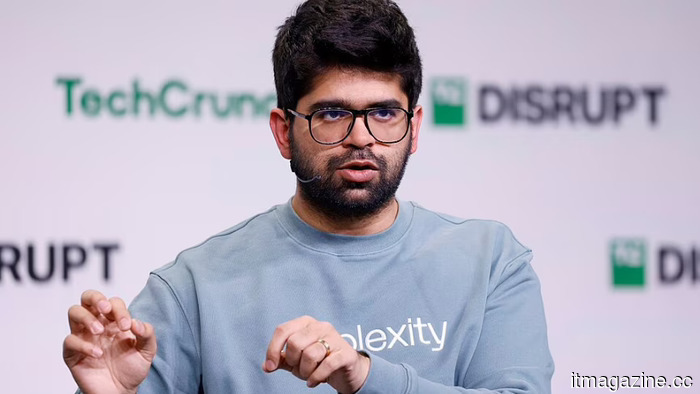 Perplexity maintains its IPO strategy for 2028 as OpenAI and Anthropic submit their filings.
Perplexity AI aims for an IPO in 2028, opting for a patient approach rather than rushing, while both OpenAI and Anthropic have submitted confidential filings. The CEO stated that the schedule remains unchanged.
Perplexity maintains its IPO strategy for 2028 as OpenAI and Anthropic submit their filings.
Perplexity AI aims for an IPO in 2028, opting for a patient approach rather than rushing, while both OpenAI and Anthropic have submitted confidential filings. The CEO stated that the schedule remains unchanged.
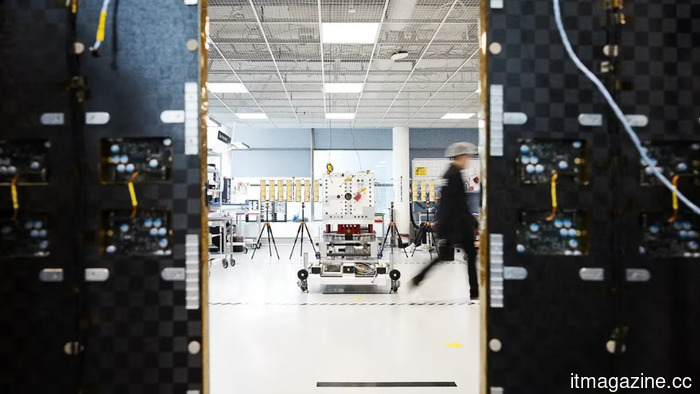 ICEYE achieves a €10 billion valuation following a €450 million fundraising round.
Finland's ICEYE secured €450 million in funding, led by General Atlantic, achieving a valuation of €10 billion, which is four times its value from six months ago, as governments accelerate efforts to acquire sovereign radar satellites.
ICEYE achieves a €10 billion valuation following a €450 million fundraising round.
Finland's ICEYE secured €450 million in funding, led by General Atlantic, achieving a valuation of €10 billion, which is four times its value from six months ago, as governments accelerate efforts to acquire sovereign radar satellites.
 Databricks is engaged in discussions to achieve a valuation of up to $175 billion.
Databricks is in discussions to raise funds at a valuation of $165-175 billion, just four months following a $5 billion funding round at a $134 billion valuation. The CEO indicates an IPO is anticipated next year. These discussions are still in the preliminary stages and the funding round has not yet been finalized.
Databricks is engaged in discussions to achieve a valuation of up to $175 billion.
Databricks is in discussions to raise funds at a valuation of $165-175 billion, just four months following a $5 billion funding round at a $134 billion valuation. The CEO indicates an IPO is anticipated next year. These discussions are still in the preliminary stages and the funding round has not yet been finalized.
 Perplexity maintains its 2028 IPO strategy as OpenAI and Anthropic submit their filings.
Perplexity AI aims for an IPO in 2028, opting for a patient approach instead of rushing, while OpenAI and Anthropic both submit their filings confidentially. The CEO states that the timeline remains unchanged.
Perplexity maintains its 2028 IPO strategy as OpenAI and Anthropic submit their filings.
Perplexity AI aims for an IPO in 2028, opting for a patient approach instead of rushing, while OpenAI and Anthropic both submit their filings confidentially. The CEO states that the timeline remains unchanged.
 Apple revamps Siri using Google AI and Nvidia processors at WWDC.
Apple's updated Siri operates on a proprietary Gemini model along with Nvidia Blackwell GPUs. Federighi claims that data is not retained. Five new AI models employ a three-tier privacy framework.
Apple revamps Siri using Google AI and Nvidia processors at WWDC.
Apple's updated Siri operates on a proprietary Gemini model along with Nvidia Blackwell GPUs. Federighi claims that data is not retained. Five new AI models employ a three-tier privacy framework.
Fujikura increases prices for AI data center cables due to tightening supply.
Fujikura is increasing the prices of fibre-optic cables as almost all US hyperscalers place orders amid tight supply. While shares have fallen by 40%, the CEO assures that the company will surpass its projections.