
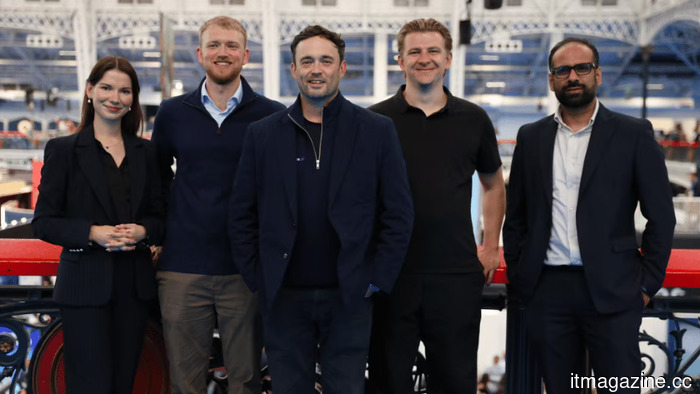
Deliverance AI emerges from stealth mode with an annual recurring revenue of £6 million for its sovereign AI solutions.
Enterprise AI faces a stagnation issue, and the problem isn't the models themselves. Companies have invested heavily in chips, private clouds, and pilot programs, only to see most stall before reaching production. A London-based firm named Deliverance AI believes it understands the cause, and on Tuesday, it emerged from the shadows to offer a solution.
Established less than a year ago, Deliverance AI claims to have achieved £6 million in annual recurring revenue, built a team of over 30 employees, and secured six enterprise clients within three months of its formation. These figures have been provided by the company and are unaudited, and Deliverance AI has not disclosed the names of its clients.
The timing of the launch coincided with London Tech Week, during which the UK government has been advocating for a sovereign computing agenda supported by billions in private funding.
Deliverance AI markets what it refers to as an agentic operating system, a governance layer designed to operate AI agents within an organization’s environment. This system manages task routing between various models, tracks the actions of the agents, and allocates costs to specific budget lines.
The primary target audience includes governments, regulated sectors, and large enterprises—organizations that possess sensitive data and are subject to numerous regulations.
“Enterprise AI will not scale based on trust-me assurances,” stated Mick McNeil, the company's founder and CEO. “Organizations with the most valuable data require AI that functions within their own environments, under their governance, with clear guidelines on model usage, data handling, and decision-making processes.”
McNeil emphasizes the difference between infrastructure and results. He contends that merely purchasing GPUs and cloud resources does not automatically create an operational AI system; the crucial missing element is a platform for running agents, governing their actions, providing necessary context, and ensuring accountability.
McNeil has significant insight into the spending aspect of this equation, having previously held senior positions in cloud computing, high-performance computing, and AI at Microsoft, Northern Data Group, and Logicalis.
The sovereignty appeal
Deliverance AI's principal argument is based on jurisdiction. As a UK-founded entity with headquarters in the UK and EU, it asserts that its platform can function in customer-managed, on-premises, or fully air-gapped settings, as opposed to being run on US-controlled infrastructure.
The key selling point is the risk of exposure: Deliverance AI argues that utilizing US-operated systems puts European data at risk of being subjected to extra-territorial laws like the US CLOUD Act, which can mandate US providers to surrender data regardless of its storage location.
This narrative aligns with an ongoing debate in Europe. Over the past year, Brussels and national administrations have grappled with the EU's reliance on US cloud providers, now considered more a political risk than merely a technical challenge. This situation has prompted a surge of startups eager to position themselves as local alternatives as Europe seeks to solve its sovereignty dilemma.
Deliverance AI enters a competitive landscape that includes firms such as Cosine, which has attracted support from British banks and defense organizations with its sovereign model. "Sovereign" has become one of the most debated terms in the industry, and not every product bearing the label effectively safeguards data from foreign control.
From pilots to production
Beneath its strategic positioning, the product serves as an orchestration and governance layer. It offers a runtime environment for agents, a model-routing feature that directs tasks to the most suitable model based on performance, cost, risk, and governance, in addition to providing audit trails, cost attribution, and an embedded engineering team.
The routing capability also acts as a safeguard for clients, preventing them from becoming dependent on a single model, cloud provider, or vendor in a rapidly changing market.
The company reports that one customer implementation reduced costs by nearly 75% while also accelerating task completion times. However, this pertains to a single unnamed deployment and is a self-reported figure, thus should be interpreted as a claim rather than a definitive metric.
The challenge it identifies is substantial: many enterprise AI pilot projects falter before reaching production, and investment is quickly shifting toward AI-native, agentic tools due to the diminishing returns of traditional per-seat software. Increasingly, governance—not just raw capabilities—determines the success or failure of deployments.
Built on HPE and Nvidia
Deliverance AI is not developing its technology entirely independently. It states that it operates on HPE Private Cloud AI, which is a private cloud infrastructure co-developed with Nvidia. This partnership can facilitate the implementation of governed agentic workflows within a client's own environment in as little as four weeks.
On the computing end, the company has implemented its solutions on Nvidia DGX systems and the smaller DGX Spark. Additionally, it collaborates with Nvidia NemoClaw, the chipmaker’s framework for controlling autonomous agents, on workflows in private and regulated environments.
Both partners have given supportive statements. Anthony Hills, Nvidia’s regional director for enterprise and public sector in the UK and Ireland, noted that this integration “provid
Other articles
 BYD claims that demand is twice the level of its capacity, yet its sales figures tell a different tale.
Stella Li from BYD indicates that China aims for 80% electric vehicle market penetration, as gasoline car sales drop by 39% and the Pentagon includes the automaker in its 1260H military roster.
BYD claims that demand is twice the level of its capacity, yet its sales figures tell a different tale.
Stella Li from BYD indicates that China aims for 80% electric vehicle market penetration, as gasoline car sales drop by 39% and the Pentagon includes the automaker in its 1260H military roster.
 China is preparing a $295 billion plan for AI data centers aimed at excluding Nvidia.
China is creating a five-year plan valued at around $295 billion to establish a national AI data center network that will rely on 80% domestic technology, effectively sidelining Nvidia and AMD.
China is preparing a $295 billion plan for AI data centers aimed at excluding Nvidia.
China is creating a five-year plan valued at around $295 billion to establish a national AI data center network that will rely on 80% domestic technology, effectively sidelining Nvidia and AMD.
 Databricks is in discussions to secure funding that could value the company at as much as $175 billion.
Databricks is in negotiations to secure funding at a valuation of $165-175 billion, just four months following a $5 billion round at a $134 billion valuation. The CEO indicates an IPO is planned for next year. These discussions are in the preliminary stages, and the funding round has yet to be finalized.
Databricks is in discussions to secure funding that could value the company at as much as $175 billion.
Databricks is in negotiations to secure funding at a valuation of $165-175 billion, just four months following a $5 billion round at a $134 billion valuation. The CEO indicates an IPO is planned for next year. These discussions are in the preliminary stages, and the funding round has yet to be finalized.
 Isar Aerospace secures €270 million to expand its rocket manufacturing capabilities.
Germany's Isar Aerospace has secured €270 million to produce 40 rockets annually and establish a second launchpad, with a crucial orbital launch opportunity beginning on June 15.
Isar Aerospace secures €270 million to expand its rocket manufacturing capabilities.
Germany's Isar Aerospace has secured €270 million to produce 40 rockets annually and establish a second launchpad, with a crucial orbital launch opportunity beginning on June 15.
 Isar Aerospace secures €270 million to expand its rocket manufacturing capabilities.
Germany's Isar Aerospace has secured €270 million to manufacture 40 rockets annually and establish a second launchpad, with a critical orbital launch opportunity set for 15 June.
Isar Aerospace secures €270 million to expand its rocket manufacturing capabilities.
Germany's Isar Aerospace has secured €270 million to manufacture 40 rockets annually and establish a second launchpad, with a critical orbital launch opportunity set for 15 June.
 Prince William highlights homelessness prevention at London Tech Week.
The Prince of Wales will lead a panel during London Tech Week alongside Salesforce, Bloomberg Philanthropies, and NatWest, focusing on the role of data and technology in preventing homelessness.
Prince William highlights homelessness prevention at London Tech Week.
The Prince of Wales will lead a panel during London Tech Week alongside Salesforce, Bloomberg Philanthropies, and NatWest, focusing on the role of data and technology in preventing homelessness.
Deliverance AI emerges from stealth mode with an annual recurring revenue of £6 million for its sovereign AI solutions.
UK startup Deliverance AI has emerged from stealth mode with an annual recurring revenue of £6 million, developing an 'agentic operating system' designed to manage governed AI within secure, air-gapped environments.