
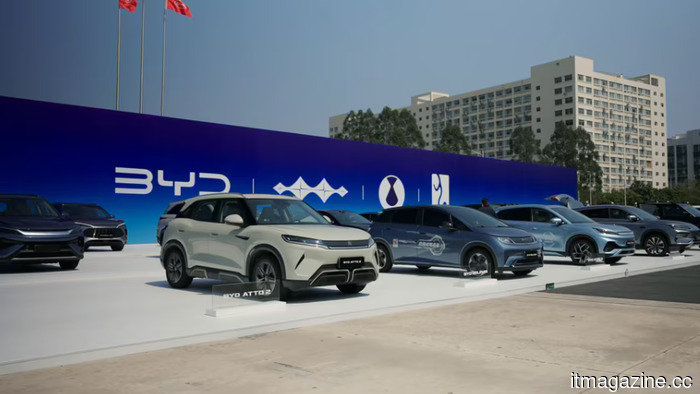
BYD claims that demand is twice the level of its capacity, yet its sales figures tell a different tale.
**TL;DR:** BYD anticipates that China will achieve 80% electric vehicle (EV) market penetration as sales of gasoline vehicles drop by 39%, but it must contend with being added to the Pentagon’s 1260H list and scrutiny over labor conditions in Hungary.
Stella Li, BYD’s executive vice president, stated on CNBC that China's EV market could approach 80% penetration, a highly optimistic outlook that contrasts with Nio's CEO William Li's assertion from last month that the industry's "golden era" has ended. This announcement coincides with the Pentagon's addition of BYD to its list of Chinese military-affiliated companies, which restricts the Department of Defense from directly contracting with these firms starting June 30, with a prohibition on procuring their products through third parties a year later.
In China, the adoption rate for hybrid and fully electric vehicles has surged to historic highs. The Chinese Passenger Car Association reported that new energy vehicles made up 62.9% of new passenger car sales in May, up from about half in 2024. During the same period, sales of gasoline cars fell by 39% compared to the previous year, with the CPCA attributing this decline to rising oil prices influenced by ongoing conflicts in the Middle East.
The penetration of electric cars in the U.S. hovers around 10%, according to the International Energy Agency’s Global EV Outlook released in May, while the global average is near 25%. The divide between China and the rest of the world continues to grow. U.S. tariffs of 100% on Chinese electric vehicles have hampered local sales, and the IEA noted that the expiration of EV tax credits is expected to lead to “virtually no government financial support for electric car purchases” in the U.S. by 2026.
Li mentioned that domestic demand for BYD’s EVs has now reached approximately twice what the company can supply, a statement that appears inconsistent with the data. In May, BYD sold 376,990 vehicles in China, which marked a year-on-year plateau, effectively ending an eight-month decline in domestic sales, but suggesting an absence of supply constraints. In the first quarter, BYD’s net profit decreased by 55% to 4.09 billion yuan due to intense price competition, while revenue fell by 12% to 150.2 billion yuan.
Li attributed the demand increase to BYD's second-generation Blade Battery and rapid charging technology showcased in March, which can charge from 10% to 70% in five minutes. BYD plans to establish around 20,000 rapid charging stations throughout China by the end of 2026. While this technology represents a significant engineering feat, independent verification of its impact on demand has not occurred.
Li indicated that the next stage of competition in China's EV sector will focus on driver-assist features. On May 28, BYD expanded insurance coverage for users of its L2+ driver-assist system, which includes both intelligent parking and urban Navigate on Autopilot functions. Li suggested this could enhance customer utilization by five percentage points to at least 95%. The company also unveiled the Xuanji A3, labeled as China's first automotive-grade 4nm driving chip with 700 TOPS of computing capability at the same event.
For the time being, BYD plans to primarily use Nvidia’s driver-assist chipsets, even though it employs around 7,000 engineers in semiconductor development. This number is a small fraction of the more than 869,600 workforce reported at the end of 2025, which reflects a reduction of nearly 100,000 from the previous year due to automation.
Leon Cheng, who leads the mobility division at Asia-focused consultancy YCP, offered a more tempered perspective: “The issue is not just whether BYD can sustain its leadership in China,” he told CNBC, “but whether it can maintain its global position as more Chinese EV manufacturers enter export markets with aggressive strategies.” BYD has faced challenges in expanding domestically, turning instead to international markets where exports surged over 80% year on year to a record 160,644 units in May.
However, this export strategy introduces its own challenges. Li revealed that BYD aims to produce 75% of the cars sold in Europe locally, but construction of its factory in Hungary has been marred by allegations from the New York-based watchdog China Labor Watch regarding forced labor practices, including excessive working hours and unpaid wages. Li has denied these allegations. The European Commission stated that this matter is under the jurisdiction of Hungarian labor authorities, who have yet to release their findings.
The Pentagon's 1260H listing does not impose direct sanctions, but it complicates BYD's already limited presence in the U.S. at a time when the company is attempting to assert its technological edge. With 100% tariffs on its vehicles in the U.S., BYD's American units filed a
Otros artículos
 Apple reconstruye Siri con la inteligencia artificial de Google y los chips de Nvidia en WWDC
El nuevo Siri de Apple funciona con un modelo Gemini personalizado y GPUs Nvidia Blackwell. Federighi dice que los datos nunca se almacenan. Cinco nuevos modelos de IA utilizan una arquitectura de privacidad de tres niveles.
Apple reconstruye Siri con la inteligencia artificial de Google y los chips de Nvidia en WWDC
El nuevo Siri de Apple funciona con un modelo Gemini personalizado y GPUs Nvidia Blackwell. Federighi dice que los datos nunca se almacenan. Cinco nuevos modelos de IA utilizan una arquitectura de privacidad de tres niveles.
 China elabora un plan de centro de datos de IA de $295 mil millones para excluir a Nvidia
China está elaborando un plan quinquenal de aproximadamente $295 mil millones para construir una red nacional de centros de datos de IA basada en un 80% de tecnología nacional, excluyendo a Nvidia y AMD.
China elabora un plan de centro de datos de IA de $295 mil millones para excluir a Nvidia
China está elaborando un plan quinquenal de aproximadamente $295 mil millones para construir una red nacional de centros de datos de IA basada en un 80% de tecnología nacional, excluyendo a Nvidia y AMD.
 El Príncipe William lleva la prevención de la falta de vivienda a la Semana de la Tecnología de Londres.
El Príncipe de Gales presidirá un panel en la Semana de la Tecnología de Londres con Salesforce, Bloomberg Philanthropies y NatWest sobre el uso de datos y tecnología para prevenir la falta de vivienda.
El Príncipe William lleva la prevención de la falta de vivienda a la Semana de la Tecnología de Londres.
El Príncipe de Gales presidirá un panel en la Semana de la Tecnología de Londres con Salesforce, Bloomberg Philanthropies y NatWest sobre el uso de datos y tecnología para prevenir la falta de vivienda.
 Databricks en conversaciones para recaudar a una valoración de hasta $175 mil millones
Databricks está en conversaciones para recaudar entre $165 y $175 mil millones, cuatro meses después de una ronda de $5 mil millones a $134 mil millones. El CEO señala una OPI el próximo año. Las discusiones están en una etapa temprana y la ronda no se ha cerrado.
Databricks en conversaciones para recaudar a una valoración de hasta $175 mil millones
Databricks está en conversaciones para recaudar entre $165 y $175 mil millones, cuatro meses después de una ronda de $5 mil millones a $134 mil millones. El CEO señala una OPI el próximo año. Las discusiones están en una etapa temprana y la ronda no se ha cerrado.
 Perplexity mantiene su plan de IPO para 2028 mientras OpenAI y Anthropic presentan.
Perplexity AI apunta a una OPI en 2028, eligiendo la paciencia sobre la urgencia mientras OpenAI y Anthropic presentan sus solicitudes de manera confidencial. El CEO dice que el cronograma no ha cambiado.
Perplexity mantiene su plan de IPO para 2028 mientras OpenAI y Anthropic presentan.
Perplexity AI apunta a una OPI en 2028, eligiendo la paciencia sobre la urgencia mientras OpenAI y Anthropic presentan sus solicitudes de manera confidencial. El CEO dice que el cronograma no ha cambiado.
 Isar Aerospace recauda 270 millones de euros para escalar su producción de cohetes
La empresa alemana Isar Aerospace ha recaudado 270 millones de euros para construir 40 cohetes al año y una segunda plataforma de lanzamiento, con una ventana de lanzamiento orbital crucial que se abrirá el 15 de junio.
Isar Aerospace recauda 270 millones de euros para escalar su producción de cohetes
La empresa alemana Isar Aerospace ha recaudado 270 millones de euros para construir 40 cohetes al año y una segunda plataforma de lanzamiento, con una ventana de lanzamiento orbital crucial que se abrirá el 15 de junio.
BYD claims that demand is twice the level of its capacity, yet its sales figures tell a different tale.
Stella Li from BYD indicates that China aims for 80% electric vehicle market penetration, as gasoline car sales drop by 39% and the Pentagon includes the automaker in its 1260H military roster.