
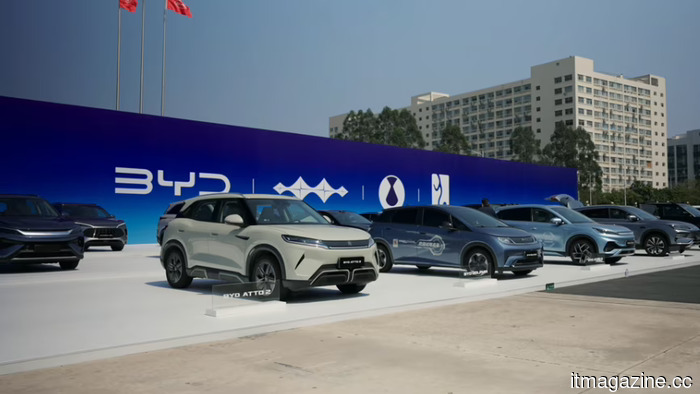
BYD claims that demand is twice its capacity, yet its sales figures suggest otherwise.
TL;DR: BYD forecasts that China will achieve 80% electric vehicle (EV) market penetration as traditional gas car sales plummet by 39%, while contending with the Pentagon’s 1260H list and labor issues in Hungary.
Stella Li, BYD’s executive vice president, shared with CNBC on Monday that China’s EV market is expected to near 80% penetration, a positive outlook that sharply contrasts with rival Nio's CEO William Li, who declared last month that the industry’s "golden era" has ended. This prediction coincides with the Pentagon's inclusion of BYD on its 1260H list of companies linked to the Chinese military, which prohibits the Department of Defense from forming contracts or acquiring products from these entities starting June 30, with restrictions extending to third-party procurement a year later.
The market share for hybrid and fully electric vehicles in China has hit record highs, with new energy vehicles comprising 62.9% of new passenger car sales in May, per the Chinese Passenger Car Association, up from about half in 2024. Meanwhile, sales of gasoline-powered cars fell by 39% year-on-year in the same month, influenced by rising oil prices resulting from ongoing conflicts in the Middle East.
The US electric vehicle market penetration is approximately 10%, as stated in the International Energy Agency’s Global EV Outlook for May, compared to around 25% globally, highlighting an expanding gap between China and the rest of the world. US tariffs of 100% on Chinese electric vehicles have hindered local sales, and the IEA noted the anticipated cessation of EV tax credits in the US by 2026, leading to an expected lack of government financial support for electric car purchases.
Li mentioned that domestic demand for BYD’s EVs is currently about double the company’s output capabilities, although this claim raises questions when matched against their sales data. In May, BYD sold 376,990 vehicles in China, which remained flat year-on-year, marking the end of an eight-month decline in domestic sales but not indicating a market constrained by supply. The company’s net profit for the first quarter dropped 55% to 4.09 billion yuan due to an intense price competition, and revenue fell 12% to 150.2 billion yuan.
Li credited the surge in demand to BYD's new Blade Battery and flash charging technology announced in March, which can charge from 10% to 70% in five minutes. BYD plans to establish around 20,000 flash charging stations in China by the end of 2026. Although this technology signifies an engineering milestone, independent verification of its impact on demand remains unconfirmed.
Li remarked that future competition in China's EV market will focus on driver-assist technologies. On May 28, BYD expanded insurance coverage for users of its L2+ driver-assist system to include intelligent parking and urban Navigate on Autopilot capabilities, potentially increasing customer utilization by 5% to at least 95%. Additionally, the company introduced the Xuanji A3, China's first automotive-grade 4nm driving chip offering 700 TOPS of computing power.
Currently, Li indicated that BYD will primarily rely on Nvidia's driver-assist chipsets, despite having about 7,000 engineers dedicated to semiconductor development. This workforce constitutes only a small fraction of BYD’s total personnel, which stood at over 869,600 at the end of 2025 according to its annual report, representing a nearly 100,000 decrease from the previous year due to automation.
Leon Cheng, head of the mobility practice at YCP consulting, expressed a more cautious viewpoint. "The real question is whether BYD can sustain its leadership in China and its global positioning as more Chinese EV manufacturers aggressively enter export markets," he shared with CNBC. BYD has encountered difficulties in growing within the domestic market, turning its focus instead to international sales, which surged over 80% year-on-year in May, hitting a record 160,644 units.
This export strategy introduces additional challenges. Li indicated that BYD intends to have 75% of its cars sold in Europe produced locally, but construction of its factory in Hungary is marred by allegations from China Labor Watch regarding forced labor conditions, such as seven-day workweeks, 14-hour shifts, and unpaid wages. Li rejected these claims. The European Commission stated that the case falls under Hungarian labor authorities, who have not released any findings.
The Pentagon’s 1260H classification does not impose direct sanctions but complicates BYD’s limited presence in the US, especially as the company attempts to assert confidence in its technological edge. With 100% tariffs on its vehicles in the US, BYD's American units filed a legal challenge in the US Court of International Trade in January, asserting the tariffs are invalid. This designation adds further regulatory scrutiny to BYD as it simultaneously forecasts market dominance at home while grappling with labor
Other articles
 China develops a $295 billion AI data center strategy to exclude Nvidia.
China is formulating a five-year plan worth approximately $295 billion to establish a national AI data center network that will be predominantly powered by 80% domestic technology, thereby reducing reliance on Nvidia and AMD.
China develops a $295 billion AI data center strategy to exclude Nvidia.
China is formulating a five-year plan worth approximately $295 billion to establish a national AI data center network that will be predominantly powered by 80% domestic technology, thereby reducing reliance on Nvidia and AMD.
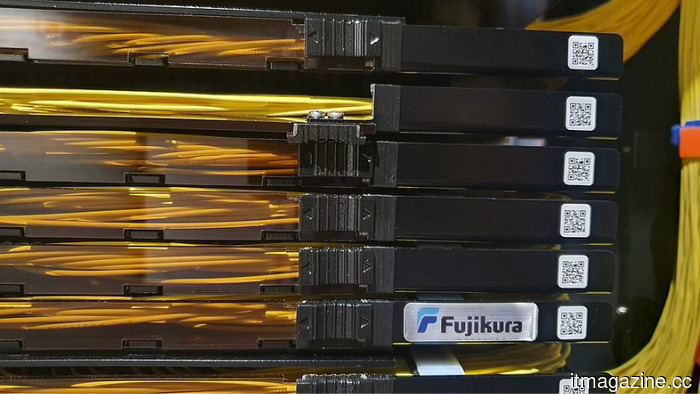 Fujikura increases prices for AI data center cables due to tightening supply.
Fujikura is increasing the prices of fibre-optic cables as almost all US hyperscalers are placing orders and supply remains limited. Although shares have fallen by 40%, the CEO asserts that the company will exceed its expectations.
Fujikura increases prices for AI data center cables due to tightening supply.
Fujikura is increasing the prices of fibre-optic cables as almost all US hyperscalers are placing orders and supply remains limited. Although shares have fallen by 40%, the CEO asserts that the company will exceed its expectations.
 Databricks is in discussions to secure funding that could value the company at as much as $175 billion.
Databricks is in negotiations to secure funding at a valuation of $165-175 billion, just four months following a $5 billion round at a $134 billion valuation. The CEO indicates an IPO is planned for next year. These discussions are in the preliminary stages, and the funding round has yet to be finalized.
Databricks is in discussions to secure funding that could value the company at as much as $175 billion.
Databricks is in negotiations to secure funding at a valuation of $165-175 billion, just four months following a $5 billion round at a $134 billion valuation. The CEO indicates an IPO is planned for next year. These discussions are in the preliminary stages, and the funding round has yet to be finalized.
 Perplexity maintains its 2028 IPO strategy as OpenAI and Anthropic submit their filings.
Perplexity AI aims for an IPO in 2028, opting for a patient approach instead of rushing, while OpenAI and Anthropic both submit their filings confidentially. The CEO states that the timeline remains unchanged.
Perplexity maintains its 2028 IPO strategy as OpenAI and Anthropic submit their filings.
Perplexity AI aims for an IPO in 2028, opting for a patient approach instead of rushing, while OpenAI and Anthropic both submit their filings confidentially. The CEO states that the timeline remains unchanged.
 Deliverance AI comes out of stealth mode with an annual recurring revenue of £6 million for sovereign AI.
UK startup Deliverance AI has emerged from stealth mode with an annual recurring revenue of £6 million, developing an 'agentic operating system' designed to manage governed AI within private, air-gapped settings.
Deliverance AI comes out of stealth mode with an annual recurring revenue of £6 million for sovereign AI.
UK startup Deliverance AI has emerged from stealth mode with an annual recurring revenue of £6 million, developing an 'agentic operating system' designed to manage governed AI within private, air-gapped settings.
 China is preparing a $295 billion plan for AI data centers aimed at excluding Nvidia.
China is creating a five-year plan valued at around $295 billion to establish a national AI data center network that will rely on 80% domestic technology, effectively sidelining Nvidia and AMD.
China is preparing a $295 billion plan for AI data centers aimed at excluding Nvidia.
China is creating a five-year plan valued at around $295 billion to establish a national AI data center network that will rely on 80% domestic technology, effectively sidelining Nvidia and AMD.
BYD claims that demand is twice its capacity, yet its sales figures suggest otherwise.
Stella Li of BYD stated that China aims for 80% electric vehicle penetration, as sales of gasoline cars fall by 39%, and the Pentagon includes the automaker on its 1260H military list.