

AI glasses allegedly utilized to record flight attendants without their permission, leading Rokid to announce a response plan.
Credit: Rokid
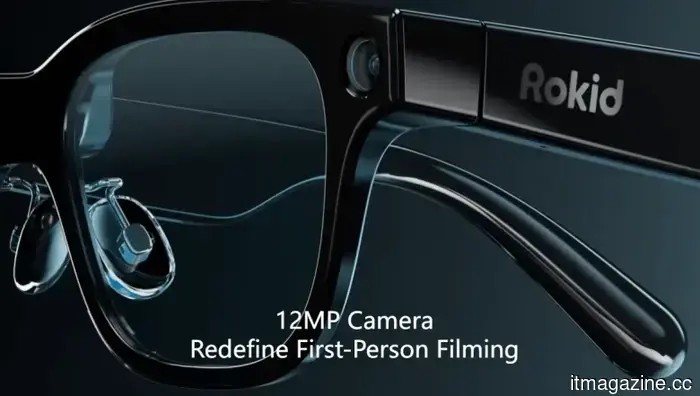
A set of seemingly normal glasses can easily be transformed into a hidden recording device using just a low-cost light-blocking sticker. This isn't a scenario from science fiction, but a real concern as AI-driven smart glasses become more prevalent in China by 2026. This week, the discussion "Are smart glasses becoming tools for covert filming? Rokid launches an urgent rectification plan" gained traction on Weibo. The issue arose from an increasing number of videos shared within the Rokid community showing flight attendants and pedestrians being recorded without their consent, as reported by Jiemian.
Credit: Rokid
Additionally, e-commerce sites have noted the sale of over 5,000 units of stickers specifically made to obscure recording indicator lights. When these stickers are applied, it becomes challenging for people nearby to detect recording activity. Audio alerts can only be heard by the user, so those in proximity cannot tell if the device is actively recording.
This matter goes beyond just user behavior; it highlights the flaws in the privacy protections built into smart wearable devices. Some models place recording indicator lights on the inside of the glasses' arms, making them less visible, and these indicators might only be lit for a short time. Audio notifications often have limited reach, and important privacy information is typically hidden in product manuals rather than clearly presented during the buying and setup process.
As wearable devices increasingly facilitate ongoing and unobtrusive image capture, it raises the question of whether current notification systems are sufficient.
Credit: Rokid
For the smart glasses sector, a critical priority is to develop comprehensive technical and governance safeguards. Recording indicators should be conspicuous, consistent, and challenging to bypass. Options such as externally visible indicator lights and obstruction detection systems could automatically halt recording when notification features are compromised.
Recording alerts should strike a balance between user convenience and the public's right to be informed, making sure that recording activities are reasonably noticeable in public spaces. Furthermore, platforms ought to enhance content moderation through technologies like AI-driven image recognition and keyword filtering to limit the spread of content potentially violating individual privacy.
Credit: Rokid
On Monday, Rokid announced that its existing products will include hardware-level recording indicators and obstruction detection capabilities, while future models will prioritize enhancing privacy protection features. These initiatives are promising, but their effectiveness will ultimately need to be assessed by the market and users.
Smart glasses, by their nature, are neutral technology. They can record daily experiences, boost productivity, and foster new forms of human-computer interaction. However, they also bring about new privacy issues.
As AI glasses transition from a specialized product category to the broader consumer market, achieving a more effective equilibrium between innovation and privacy protection may become one of the industry's most significant challenges.
Jessie Wu is a tech journalist located in Shanghai. She reports on consumer electronics, semiconductors, and the gaming sector for TechNode. You can reach her via email at jessie.wu@technode.com. More articles by Jessie Wu.



Other articles
 Ampera develops a thorium fuel supply chain that spans from an Australian mine to the United States.
Ampera established an Australian subsidiary to obtain thorium for its TRISO fuel program, with the goal of creating a vertically integrated nuclear fuel supply chain. Currently, no reactor is in operation.
Ampera develops a thorium fuel supply chain that spans from an Australian mine to the United States.
Ampera established an Australian subsidiary to obtain thorium for its TRISO fuel program, with the goal of creating a vertically integrated nuclear fuel supply chain. Currently, no reactor is in operation.
 Lucid Gravity receives hands-free highway driving capability through an OTA update.
Lucid has introduced hands-free highway driving for the Gravity SUV with the update UX 3.6, which includes features such as automated lane changes, adaptive headlights, and Google Maps point of interest data. This is available in the US and Canada now.
Lucid Gravity receives hands-free highway driving capability through an OTA update.
Lucid has introduced hands-free highway driving for the Gravity SUV with the update UX 3.6, which includes features such as automated lane changes, adaptive headlights, and Google Maps point of interest data. This is available in the US and Canada now.
 OpenAI has confidentially submitted paperwork for its IPO as competitors in the AI sector hurry to go public.
OpenAI submitted a confidential IPO application with Goldman Sachs and Morgan Stanley. Last week, Anthropic filed with a valuation of $965 billion. SpaceX is set to go public on Thursday. Three major AI listings in just a few months.
OpenAI has confidentially submitted paperwork for its IPO as competitors in the AI sector hurry to go public.
OpenAI submitted a confidential IPO application with Goldman Sachs and Morgan Stanley. Last week, Anthropic filed with a valuation of $965 billion. SpaceX is set to go public on Thursday. Three major AI listings in just a few months.
 Ampera develops a thorium fuel supply chain from an Australian mine to the United States.
Ampera established an Australian subsidiary to procure thorium for its TRISO fuel initiative, with the goal of creating a vertically integrated nuclear fuel supply chain. Currently, no reactors are in operation.
Ampera develops a thorium fuel supply chain from an Australian mine to the United States.
Ampera established an Australian subsidiary to procure thorium for its TRISO fuel initiative, with the goal of creating a vertically integrated nuclear fuel supply chain. Currently, no reactors are in operation.
 The first Yandex headphones with AI features
Yandex has started selling the "Yandex Drops" headphones — the company's first wearable AI device with support for Alice AI.
The first Yandex headphones with AI features
Yandex has started selling the "Yandex Drops" headphones — the company's first wearable AI device with support for Alice AI.
 OpenAI has confidentially submitted paperwork for an IPO as competitors in the AI sector accelerate their plans to go public.
OpenAI has confidentially submitted its IPO application with Goldman Sachs and Morgan Stanley. Last week, Anthropic filed for an IPO valued at $965 billion. SpaceX is set to list on Thursday. There have been three major AI listings in just a few months.
OpenAI has confidentially submitted paperwork for an IPO as competitors in the AI sector accelerate their plans to go public.
OpenAI has confidentially submitted its IPO application with Goldman Sachs and Morgan Stanley. Last week, Anthropic filed for an IPO valued at $965 billion. SpaceX is set to list on Thursday. There have been three major AI listings in just a few months.
AI glasses allegedly utilized to record flight attendants without their permission, leading Rokid to announce a response plan.
A set of apparently regular glasses can be transformed into a hidden recording device using just an inexpensive light-blocking sticker. This is not a