
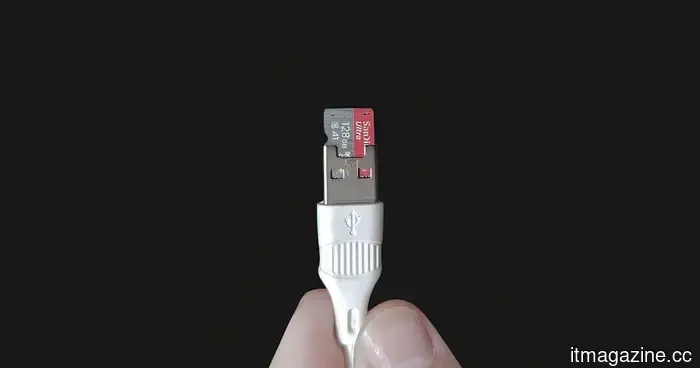
This "ordinary" USB cable has hidden aspirations of transforming into a hacking device.
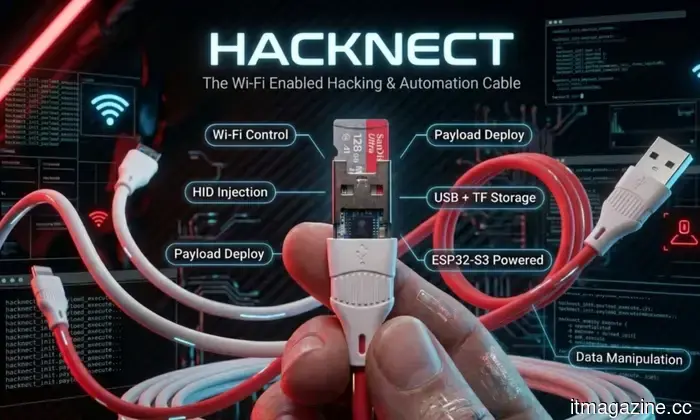
At first sight, it appears to be just a typical USB cable. However, a new Kickstarter initiative called Hacknect aims to transform something as commonplace as a charging cable into a surprisingly potent hacking and automation tool. This product targets ethical hackers, cybersecurity researchers, developers, and automation fans. Concealed within the cable is a small Wi-Fi-enabled computer powered by an ESP32-S3 chip, enabling it to perform much more than just charging a phone or transferring files.
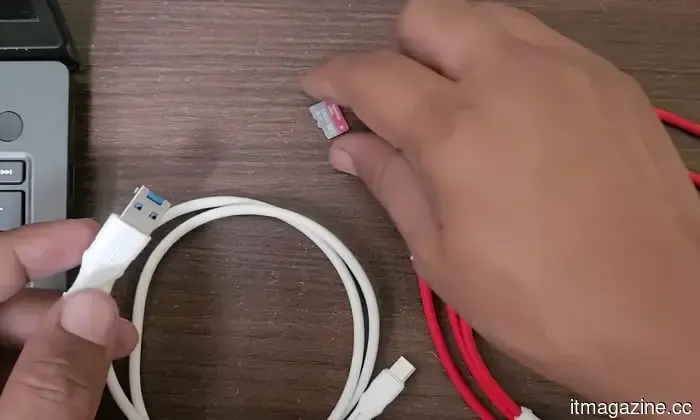
According to the Kickstarter campaign, Hacknect can execute scripts remotely, automate tasks, emulate keyboard inputs, and even conceal files via a built-in microSD card slot. Users can wirelessly manage the cable through a browser dashboard or a smartphone app.
In simple terms, when plugged into a computer, this cable can act like a keyboard, automatically entering commands or executing scripts. This has led many to draw parallels with tools like the USB Rubber Ducky and O.MG Cable, which are already well-known in cybersecurity for penetration testing and security training.
What makes this cable noteworthy
What’s intriguing is not just the capabilities of Hacknect, but its discreet appearance while performing them.
Cybersecurity tools traditionally looked like complex tech or bulky devices. Nowadays, they are increasingly camouflaged as everyday items. A charging cable concealing a wireless hacking platform feels reminiscent of something from a spy film, which is precisely why projects like this capture attention online so rapidly.
Hacknect on Kickstarter
For professionals, there are genuine applications. Security teams frequently use devices like these to assess employees’ ability to recognize malicious USB devices or to simulate authentic cyberattacks during training scenarios. Automation enthusiasts can utilize them for repetitive tasks, scripting, or managing devices remotely.
However, this discussion also has an unsettling aspect.
Because the cable appears entirely normal, detractors argue that its features could be misused if handled irresponsibly. A device that can remotely inject commands into a computer inherently raises alarms about unauthorized access and physical cybersecurity risks.
What makes tools like Hacknect alarming is their seamless integration into everyday life. Most individuals would never suspect that an ordinary-looking charging cable could covertly execute commands, inject keystrokes, or communicate wirelessly. This creates a significant trust issue regarding physical device security.
In the wrong hands, such tools could potentially be exploited to steal data, install malicious software, or gain unauthorized access to systems without immediately arousing suspicion. Since the cable seems entirely typical, victims might connect it to their personal laptops, office systems, or communal computers without a second thought. Cybersecurity experts have long warned that detecting physical hardware attacks is becoming increasingly difficult – and products like this highlight the reason why.
The broader trend behind it
Hacknect also mirrors a larger trend currently unfolding in cybersecurity. As software defenses grow stronger, both researchers and attackers are focusing more intently on hardware-based attack strategies.
Simultaneously, Western companies are paying more attention to the hardware innovations emerging from smaller developer communities and independent tech initiatives. Crowdfunding platforms like Kickstarter have become a launchpad for niche cybersecurity devices that might have otherwise remained concealed within underground forums or specialized circles.
That said, such products still occupy a gray area. The creators heavily promote Hacknect as an ethical hacking and educational tool, but like many cybersecurity devices, the intent behind their usage is far more significant than the gadget itself.
And while it may resemble an ordinary cable resting on a desk, Hacknect serves as a reminder that modern cybersecurity threats are increasingly lurking in plain sight.
Other articles
 Good Lock is the reason I continue to return to the Galaxy S26.
After using Good Lock on my Galaxy S26, Samsung's software transitioned from feeling like a static interface to something that I could genuinely customize to match my personal preferences.
Good Lock is the reason I continue to return to the Galaxy S26.
After using Good Lock on my Galaxy S26, Samsung's software transitioned from feeling like a static interface to something that I could genuinely customize to match my personal preferences.
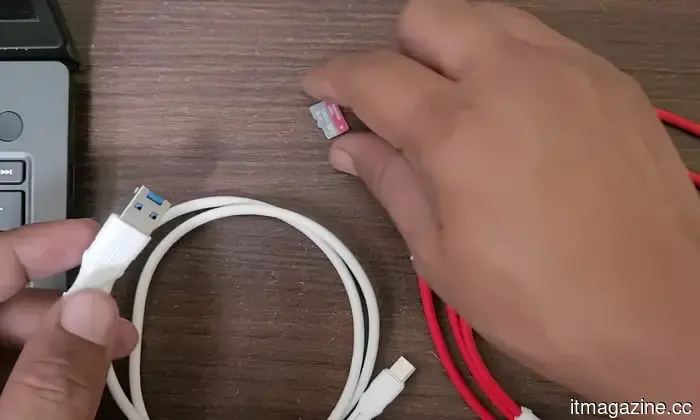 This "ordinary" USB cable has a hidden desire to function as a hacking tool.
A new Kickstarter initiative named Hacknect conceals a Wi-Fi-enabled hacking and automation platform within what seems to be a regular USB cable.
This "ordinary" USB cable has a hidden desire to function as a hacking tool.
A new Kickstarter initiative named Hacknect conceals a Wi-Fi-enabled hacking and automation platform within what seems to be a regular USB cable.
 India's SolarSquare is securing $60 million with a valuation of $500 million. The company has energized 50,000 households.
B Capital and Lightspeed are jointly leading the Series C round, which has resulted in the startup's valuation doubling within 18 months. India has become the third-largest solar producer globally.
India's SolarSquare is securing $60 million with a valuation of $500 million. The company has energized 50,000 households.
B Capital and Lightspeed are jointly leading the Series C round, which has resulted in the startup's valuation doubling within 18 months. India has become the third-largest solar producer globally.
 A billionaire from the cryptocurrency world will guide humanity to Mars aboard Musk's Starship.
The inaugural human journey to Mars by SpaceX might be commanded by Chun Wang, a cryptocurrency billionaire who has already completed one private astronaut mission.
A billionaire from the cryptocurrency world will guide humanity to Mars aboard Musk's Starship.
The inaugural human journey to Mars by SpaceX might be commanded by Chun Wang, a cryptocurrency billionaire who has already completed one private astronaut mission.
 The Gulf was expected to drive the AI surge. Then the conflict began.
Oil prices have reached $100, the Strait of Hormuz is shut down, and investments in data centers are currently on hold. The Gulf's investment in AI is undergoing its initial significant challenge.
The Gulf was expected to drive the AI surge. Then the conflict began.
Oil prices have reached $100, the Strait of Hormuz is shut down, and investments in data centers are currently on hold. The Gulf's investment in AI is undergoing its initial significant challenge.
 3 MacBook games that are more impactful than many films and don’t require gaming skills.
If you own a MacBook and have never considered yourself a gamer, these three narrative-driven games are simple to dive into, emotionally impactful, and unexpectedly memorable.
3 MacBook games that are more impactful than many films and don’t require gaming skills.
If you own a MacBook and have never considered yourself a gamer, these three narrative-driven games are simple to dive into, emotionally impactful, and unexpectedly memorable.
This "ordinary" USB cable has hidden aspirations of transforming into a hacking device.
A new Kickstarter initiative named Hacknect conceals a Wi-Fi-capable hacking and automation platform within what seems to be a typical USB cable.