
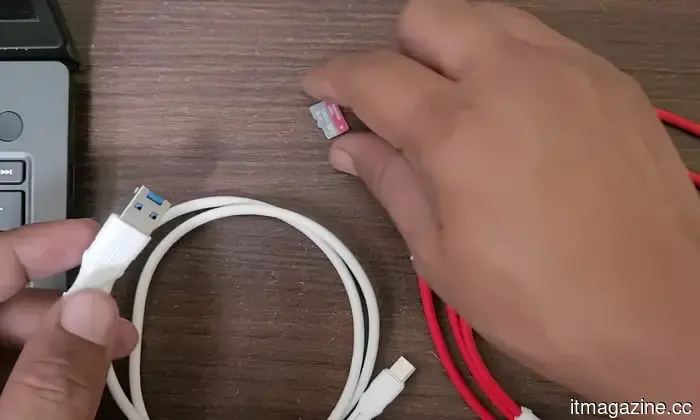
This "ordinary" USB cable has a hidden desire to function as a hacking tool.
At first glance, it appears to be just a standard USB cable. However, a new Kickstarter initiative named Hacknect aims to transform something as commonplace as a charging cable into a surprisingly effective hacking and automation tool. This product is targeted at ethical hackers, cybersecurity researchers, developers, and automation fans. Inside the cable is a small computer equipped with Wi-Fi capabilities powered by an ESP32-S3 chip, enabling it to perform much more than mere phone charging or file transfers.
As stated in the Kickstarter campaign, Hacknect can execute scripts remotely, automate processes, mimic keyboard input, and even conceal files using a built-in microSD card slot. Users can purportedly manage the cable wirelessly through a browser dashboard or mobile device.
In simple terms, once it is connected to a computer, the cable can simulate a keyboard and automatically input commands or execute scripts. This is why many are comparing it to tools like the USB Rubber Ducky and O.MG Cable, which are already well-regarded within cybersecurity for penetration testing and security training.
What makes this cable noteworthy
The intriguing aspect is not only what Hacknect is capable of but also how inconspicuous it appears while doing so.
Historically, cybersecurity tools looked like specialized hardware or cumbersome devices. Nowadays, they are increasingly being camouflaged as everyday items. A charging cable that covertly features a wireless hacking system feels reminiscent of something from a spy film, which is why projects like this capture attention quickly online.
In the realm of professionals, there are valid applications for such a device. Security teams often utilize devices like these to assess whether employees can recognize malicious USB devices or to replicate real-world cyberattacks during training sessions. Automation enthusiasts might also employ them for repetitive tasks, scripting, or managing devices remotely.
Nevertheless, this conversation also has its darker aspects.
Given that the cable appears entirely ordinary, critics contend that the same capabilities could be misused if wielded irresponsibly. A device capable of remotely injecting commands into a computer naturally raises alarms about unauthorized access and physical cybersecurity vulnerabilities.
What renders devices like Hacknect problematic is their ability to seamlessly integrate into everyday life. Most individuals would never dream that a standard-looking charging cable could quietly execute commands, inject keystrokes, or communicate over Wi-Fi. This creates significant trust issues regarding the security of physical devices.
In the hands of ill-intentioned individuals, tools like this could potentially facilitate data theft, malware installation, or unauthorized system access without immediately arousing suspicion. Since the cable looks completely regular, victims may inadvertently connect it to personal laptops, workplace computers, or shared machines without a second thought. Cybersecurity experts have long cautioned that physical hardware attacks are becoming increasingly difficult to detect – and products like this illustrate why.
The broader trend at play
Hacknect also represents a more extensive shift occurring within cybersecurity at present. As software defenses strengthen, both researchers and attackers are focusing more on hardware-based assault strategies.
Concurrent with this, Western companies are becoming increasingly attentive to hardware innovations emerging from smaller developer communities and independent tech initiatives. Crowdfunding sites like Kickstarter have turned into platforms for launching niche cybersecurity gadgets that might have previously remained confined to underground forums or specialized circles.
That being said, products like this still operate in a gray area. The creators actively promote Hacknect as a tool for ethical hacking and education, but like most cybersecurity hardware, the intention behind its use is far more significant than the device itself.
While it may resemble an inconspicuous cable resting on a desk, Hacknect serves as a stark reminder that contemporary cybersecurity threats are beginning to hide in plain sight.
Other articles
 The Apple Watch is now 11 years old and is beginning to lose its impact. Competitors without screens are gaining traction in the upcoming phase.
Whoop, Oura, and Google's Fitbit Air are transforming wearables through AI coaching and passive tracking. In contrast, Apple's Health app still seems to be in a state of limbo.
The Apple Watch is now 11 years old and is beginning to lose its impact. Competitors without screens are gaining traction in the upcoming phase.
Whoop, Oura, and Google's Fitbit Air are transforming wearables through AI coaching and passive tracking. In contrast, Apple's Health app still seems to be in a state of limbo.
 3 MacBook games that are more impactful than many films and don’t require gaming skills.
If you own a MacBook and have never considered yourself a gamer, these three narrative-driven games are simple to dive into, emotionally impactful, and unexpectedly memorable.
3 MacBook games that are more impactful than many films and don’t require gaming skills.
If you own a MacBook and have never considered yourself a gamer, these three narrative-driven games are simple to dive into, emotionally impactful, and unexpectedly memorable.
 The US has placed Anthropic on its blacklist due to security concerns. Nevertheless, its intelligence agencies are still utilizing Claude.
A shortage of chips compelled the White House to permit the NSA to utilize Anthropic's AI. An emergency request for $9 billion will finance classified data centers for Nvidia chips.
The US has placed Anthropic on its blacklist due to security concerns. Nevertheless, its intelligence agencies are still utilizing Claude.
A shortage of chips compelled the White House to permit the NSA to utilize Anthropic's AI. An emergency request for $9 billion will finance classified data centers for Nvidia chips.
 A billionaire from the cryptocurrency world will guide humanity to Mars aboard Musk's Starship.
The inaugural human journey to Mars by SpaceX might be commanded by Chun Wang, a cryptocurrency billionaire who has already completed one private astronaut mission.
A billionaire from the cryptocurrency world will guide humanity to Mars aboard Musk's Starship.
The inaugural human journey to Mars by SpaceX might be commanded by Chun Wang, a cryptocurrency billionaire who has already completed one private astronaut mission.
 The police have joined the conversation and are advocating for social media restrictions for users younger than 16.
UK police have decided they can no longer wait for tech companies to take action and are now urging the government to completely prohibit under-16s from accessing unsafe platforms.
The police have joined the conversation and are advocating for social media restrictions for users younger than 16.
UK police have decided they can no longer wait for tech companies to take action and are now urging the government to completely prohibit under-16s from accessing unsafe platforms.
 Google is not discontinuing your old and aging Chromecast, contrary to what you might have thought.
Google has announced that the casting problems impacting older Chromecast devices have been fixed, alleviating users' concerns that the company had silently discontinued support for the aging hardware.
Google is not discontinuing your old and aging Chromecast, contrary to what you might have thought.
Google has announced that the casting problems impacting older Chromecast devices have been fixed, alleviating users' concerns that the company had silently discontinued support for the aging hardware.
This "ordinary" USB cable has a hidden desire to function as a hacking tool.
A new Kickstarter initiative named Hacknect conceals a Wi-Fi-enabled hacking and automation platform within what seems to be a regular USB cable.