

From humidity to energy: Researchers demonstrate how kitchen objects can generate power for wearables and smart home gadgets.
Researchers have created a biodegradable electricity generator utilizing gelatin, salt, and charcoal.
What if the humidity in your environment could power your fitness tracker or smart home sensors? This is precisely what an international team led by scientists at Queen Mary University of London has accomplished.
Their innovative device, named the Moisture-Electric Generator (MEG), converts moisture in the air into usable electricity using only three common kitchen ingredients: gelatin, table salt, and activated charcoal.
How does it function?
The MEG operates by absorbing water molecules from the atmosphere or directly from the skin. As the gelatin and salt blend dries, it naturally divides into three separate layers without any complex manufacturing processes.
This layered structure creates a moisture gradient, facilitating ion movement through the material and producing a consistent electrical output of approximately 1 volt per unit for over 30 days.
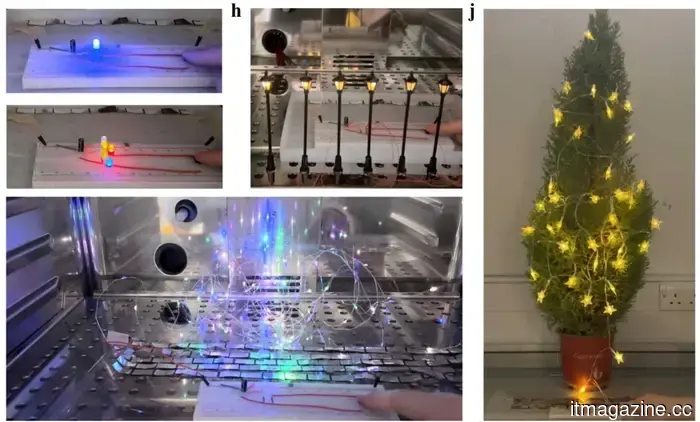
When 100 units are connected in series, the output increases to 90 volts and 5.08 milliamps, which is sufficient to power a string of 40 decorative lights. This 100-unit assembly weighs only 6.7 grams and occupies less space than a standard AA battery, which generates just 1.5 volts.
It can detect your breathing and biodegrades in soil after use.
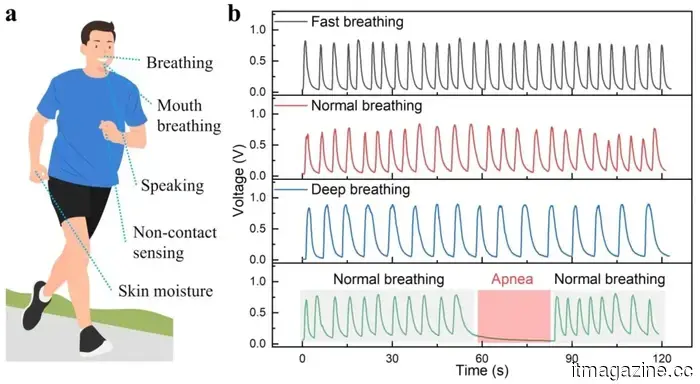
In addition to generating energy, the MEG also functions as a self-powered sensor. It can monitor breathing patterns in real time by detecting changes in exhaled moisture, count syllables in spoken words, and assess skin hydration levels.
Touchless proximity sensing is feasible as well, since the natural moisture from a nearby fingertip is enough to induce a voltage response. The most advantageous aspect is that the device decomposes in soil within three weeks and can be recycled by dissolving it in water and reforming it without losing performance.
The MEG adds to an expanding portfolio of battery-free energy innovations. Researchers have previously showcased devices such as a protein nanowire that captures electricity from atmospheric moisture, a bionic mushroom that generates power through bacteria, and nearly invisible solar cells thin enough to be applied to car windows.
Manisha Priyadarshini is a writer specializing in technology and entertainment with more than nine years of editorial experience.
The continued impact of romantic AI bots is leading to troubling situations, with the latest incident being particularly alarming.
This scenario feels reminiscent of a Black Mirror episode, yet it's entirely real. For years, romantic interactions with AI seemed like far-off science fiction, but reality has moved in unexpectedly quickly and is proving to be quite disturbing. A revealing new report from the Wall Street Journal recounts how a 57-year-old man became emotionally fixated on a personalized ChatGPT companion called “AImee,” leading to a downward spiral involving delusions, financial detriment, hospitalization, and damaged relationships.
DeepSeek, a Chinese AI startup, has significantly reduced the cost of its leading AI model by 75%, which could indicate a major shift in the industry.
DeepSeek has made a noteworthy pricing change in the AI market by permanently reducing the price of its flagship V4-Pro AI model by 75%, dropping costs to a fraction of what developers paid just weeks prior. AI companies globally have been grappling with high infrastructure expenses and limited access to high-end AI chips. Therefore, such an aggressive and permanent price reduction typically signals important behind-the-scenes changes.
DeepSeek reports that usage costs for the V4-Pro now range from 0.025 to 6 yuan per million tokens, depending on the type of workload, a significant decrease from the previous range of 0.1 to 24 yuan per million tokens. For developers working on AI applications, agents, and services, this price drop could considerably decrease operational costs.
Starbucks has decided to discontinue its AI inventory management tool due to its inability to perform as effectively as humans.
Over the last two years, technology companies have fervently marketed the idea that AI is poised to replace substantial portions of repetitive human employment. However, Starbucks has recently realized that accurately identifying milk cartons within a coffee shop is more challenging than promised by Silicon Valley.
According to a Reuters report, the coffee giant is officially terminating its AI-enhanced inventory counting system across North America, a mere nine months after its rollout. This tool, created to automate stock counts and mitigate in-store shortages, reportedly faced ongoing issues with miscounts and labeling errors, including misidentifying similar types of milk or completely overlooking certain products.





Other articles
 A billionaire from the cryptocurrency world will guide humanity to Mars aboard Musk's Starship.
The inaugural human journey to Mars by SpaceX might be commanded by Chun Wang, a cryptocurrency billionaire who has already completed one private astronaut mission.
A billionaire from the cryptocurrency world will guide humanity to Mars aboard Musk's Starship.
The inaugural human journey to Mars by SpaceX might be commanded by Chun Wang, a cryptocurrency billionaire who has already completed one private astronaut mission.
 India's SolarSquare is securing $60 million with a valuation of $500 million. The company has energized 50,000 households.
B Capital and Lightspeed are jointly leading the Series C round, which has resulted in the startup's valuation doubling within 18 months. India has become the third-largest solar producer globally.
India's SolarSquare is securing $60 million with a valuation of $500 million. The company has energized 50,000 households.
B Capital and Lightspeed are jointly leading the Series C round, which has resulted in the startup's valuation doubling within 18 months. India has become the third-largest solar producer globally.
 The US has placed Anthropic on its blacklist due to security concerns. Nevertheless, its intelligence agencies are still utilizing Claude.
A shortage of chips compelled the White House to permit the NSA to utilize Anthropic's AI. An emergency request for $9 billion will finance classified data centers for Nvidia chips.
The US has placed Anthropic on its blacklist due to security concerns. Nevertheless, its intelligence agencies are still utilizing Claude.
A shortage of chips compelled the White House to permit the NSA to utilize Anthropic's AI. An emergency request for $9 billion will finance classified data centers for Nvidia chips.
 The Apple Watch is now 11 years old and is losing its edge. Competitors without screens are taking the lead in the upcoming phase.
Whoop, Oura, and Google's Fitbit Air are transforming wearables through AI coaching and passive tracking, while Apple's Health app seems to be in a state of limbo.
The Apple Watch is now 11 years old and is losing its edge. Competitors without screens are taking the lead in the upcoming phase.
Whoop, Oura, and Google's Fitbit Air are transforming wearables through AI coaching and passive tracking, while Apple's Health app seems to be in a state of limbo.
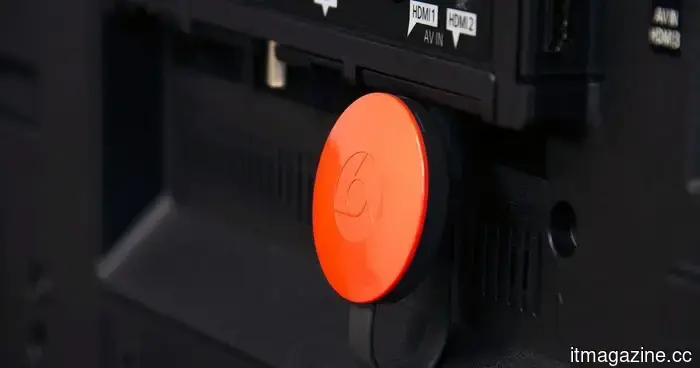 Google is not discontinuing your old and aging Chromecast, contrary to what you might have thought.
Google has announced that the casting problems impacting older Chromecast devices have been fixed, alleviating users' concerns that the company had silently discontinued support for the aging hardware.
Google is not discontinuing your old and aging Chromecast, contrary to what you might have thought.
Google has announced that the casting problems impacting older Chromecast devices have been fixed, alleviating users' concerns that the company had silently discontinued support for the aging hardware.
 The Gulf was expected to drive the AI surge. Then the conflict began.
Oil prices have reached $100, the Strait of Hormuz is shut down, and investments in data centers are currently on hold. The Gulf's investment in AI is undergoing its initial significant challenge.
The Gulf was expected to drive the AI surge. Then the conflict began.
Oil prices have reached $100, the Strait of Hormuz is shut down, and investments in data centers are currently on hold. The Gulf's investment in AI is undergoing its initial significant challenge.
From humidity to energy: Researchers demonstrate how kitchen objects can generate power for wearables and smart home gadgets.
A novel biodegradable gadget composed of gelatin, table salt, and activated charcoal has the ability to produce electricity from the moisture in the air, paving the way for innovative battery-free wearable technology.