
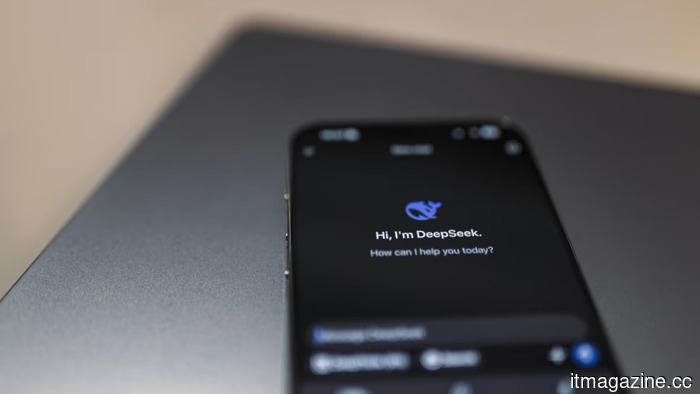
DeepSeek has made its 75% discount a permanent offer. The competition in the AI pricing battle has intensified.
**TL;DR** DeepSeek has permanently reduced the prices of its V4 Pro model by 75%, now costing $0.87 per million output tokens, which undercuts competitors like GPT-5, Gemini, and Claude.
DeepSeek has established a permanent 75% price cut for its V4 Pro flagship model, originally set to end on May 31. The prices now range from $0.003625 to $0.87 per million tokens, a decrease from $0.0145 to $3.48.
These prices stand out when compared to major competitors: OpenAI’s GPT-5 charges $2.50 per million input tokens and $10 for output, while Anthropic’s Claude Opus 4.7 charges $5 for input and $25 for output. Google’s Gemini 3.5 Flash, designed for cost efficiency, has input and output prices of $0.15 and $0.60 per million tokens, respectively. DeepSeek V4 Pro’s new pricing is lower than all these competitors, especially against the high-end reasoning models that businesses depend on for demanding tasks.
The decision to cement the discount just a month post-launch suggests that DeepSeek is prioritizing market presence over profit per unit. The company stated that V4 ushers in a "new era of cost-effective one million context length," positioning its models as ideal for tasks like processing extensive documents, codebases, or chat histories, where token costs accumulate quickly.
For companies using millions of tokens daily, the savings are significant. For instance, Salesforce anticipates spending $300 million on Anthropic tokens this year. Under DeepSeek's new pricing, an equivalent usage would cost substantially less.
Enterprise buyers must consider if DeepSeek’s model quality, reliability, and compliance can warrant a switch. The pricing advantage may be balanced by the geopolitical risks and technical concerns associated with using a Chinese AI provider, differing by industry and data sensitivity.
The competitive situation is further complicated by Anthropic's accusations that DeepSeek engaged in "distillation attacks," suggesting that DeepSeek improperly trained its models using Claude’s responses. DeepSeek has yet to publicly respond in detail to these claims.
If proven accurate, it could imply that some of DeepSeek's advantages arose from Anthropic's investment in research, and the price differences would reflect intellectual property exploitation rather than engineering efficiency. These claims remain unresolved.
Anthropic's annual revenue skyrocketed from $9 billion to $30 billion between late 2025 and early April 2026, primarily due to enterprise adoption of Claude Code. DeepSeek's pricing strategy threatens the revenue-per-token model that underpins Anthropic’s growth trajectory.
If enterprises start channeling simpler tasks to DeepSeek while reserving Claude for more complex reasoning, Anthropic could see a stabilizing token volume while experiencing a decrease in revenue per token. The larger AI pricing environment has been trending toward commoditization throughout 2026. Google has consistently lowered Gemini prices to compete against open-weight models.
OpenAI has also shifted towards consumer-centric features such as personal finance tools and advertising, indicating an understanding that relying solely on API token revenue may not uphold its $852 billion valuation. DeepSeek's persistent price reduction speeds up a trend that is already tightening profit margins across the sector. The time of high-margin AI tokens may be concluding more rapidly than anticipated.
DeepSeek V4 Pro now offers a one-million-token context window at the new price, making it suitable for applications in document analysis, legal reviews, and codebase comprehension—areas where input cost is often a limiting factor for adoption.
The combination of cutting-edge capabilities and dramatically lower pricing creates a real dilemma for CTOs. The least expensive option also comes with more geopolitical complexities, less transparency regarding training data sources, and an unresolved intellectual property accusation from a formidable rival.
DeepSeek seems to be betting that price will prevail, believing enough demand will shift to the cheapest capable model, regardless of its origins. The geopolitical challenges may hinder adoption in government and regulated sectors, but this may not deter the broader market from engaging.
The success of this strategy hinges on whether Western AI companies can bridge the price gap before DeepSeek narrows the capability gap. The alternative could lead to a market divided between Western and Chinese tiers, each with fundamentally distinct economic conditions. DeepSeek's recent actions have widened this divide.
Other articles
 AI is putting an end to affordable smartphones. The memory that fuels your device is now being redirected to data centers instead.
LPDDR prices increased by 250% over the course of a year as Samsung, SK Hynix, and Micron shifted their wafers towards AI. The sub-$100 smartphone market in India plummeted by 59%.
AI is putting an end to affordable smartphones. The memory that fuels your device is now being redirected to data centers instead.
LPDDR prices increased by 250% over the course of a year as Samsung, SK Hynix, and Micron shifted their wafers towards AI. The sub-$100 smartphone market in India plummeted by 59%.
 Stellantis aims to manufacture Chinese electric vehicles in Canada and Mexico, but not in the United States.
CEO Filosa stated that Stellantis recognizes an opportunity for Leapmotor vehicles in Canada and Mexico. A dormant plant close to Toronto may serve as the initial production facility.
Stellantis aims to manufacture Chinese electric vehicles in Canada and Mexico, but not in the United States.
CEO Filosa stated that Stellantis recognizes an opportunity for Leapmotor vehicles in Canada and Mexico. A dormant plant close to Toronto may serve as the initial production facility.
DeepSeek has made its 75% discount a permanent offer. The competition in the AI pricing battle has intensified.
DeepSeek V4 Pro is now priced at $0.87 for every million output tokens, which is a small fraction of the costs for GPT-5 and Gemini. Anthropic has alleged that the company is engaging in distillation attacks.