

The reason the EU is currently insisting on access to Anthropic's Mythos.
An Anthropic AI model that can identify zero-day vulnerabilities in all major operating systems has emerged as both a geopolitical and a prudential issue. The Eurogroup convened in Brussels on Monday without any solutions at hand.
Traditionally, Monday mornings in early May in Brussels are not known for discussions about the world's most powerful AI models. The Eurogroup meets in a spacious yet practical room, where finance ministers present their position papers. The agenda typically focuses on operational resilience, banking union complexities, and the precise phrasing of Council conclusions, rarely producing headlines.
However, on May 4, the focus shifted. Bloomberg reported that euro-area finance ministers were gathered to deliberate over Anthropic’s Mythos AI model and the challenge posed by the fact that no European government currently has access to it. This model, revealed by Anthropic on April 7, is capable of identifying and potentially exploiting zero-day vulnerabilities across every major operating system and web browser.
The White House has spent recent weeks blocking Anthropic's proposal to broaden access to approximately 70 additional organizations. Meanwhile, Europe’s banking regulators have been calculating the implications of this access gap for the financial system.
Anthropic outlined the capabilities of the system in its Project Glasswing announcement on April 7, emphasizing that Mythos Preview represents a cutting-edge model that surpasses the ability of all but the most adept human researchers in finding software vulnerabilities.
In just a few days, it uncovered thousands of high-severity vulnerabilities, such as a 27-year-old bug in OpenBSD, a 16-year-old remote-code-execution flaw in FreeBSD, and 271 Firefox vulnerabilities patched by Mozilla after a single assessment.
According to cryptography researcher Bruce Schneier and others examining the strategic importance of the model, the implications for defenders are clear. An attacker with this model possesses a structural advantage over defenders, who cannot compete without similar access. Consequently, defenders lacking equivalent access are significantly disadvantaged, a calculation that European banking supervisors have been evaluating.
Germany's Bundesbank took the lead. In late April, Germany's central bank publicly urged the EU to seek access to Mythos, asserting that without it, European banks could not effectively test their infrastructures against the threats that an adversary equipped with the model could pose. The European Central Bank also initiated calls with risk officers from eurozone banks to gather insights on their preparations for AI-driven cyberattacks. Christine Lagarde, the ECB president, described Anthropic as a responsible operator while cautioning that the model could have dire consequences in the wrong hands.
Switzerland's regulatory authority went even further. FINMA warned in April that granting widespread access to Mythos could itself create systemic risks for Swiss banks—not due to any malicious intent of the model, but because deploying such offensive security capabilities without adequate defensive infrastructure could overwhelm internal response systems. Australia’s ASIC joined the monitoring effort separately, and Kristalina Georgieva, managing director of the IMF, stated at the Fund’s spring meetings that the international monetary system lacks necessary protections against a prolonged AI-enhanced cyber incident.
While these statements are not groundbreaking, the rapid alignment around a single product is unprecedented.
Why is the White House opposed to broader access? The Trump administration argues that expanding access to Mythos raises two main concerns. First, there is the risk of misuse: a model with the ability to create exploits cannot be safely disseminated. Second, there are operational issues: the infrastructure required for wider access—including cleared facilities, access controls, and monitoring—does not exist for the extensive user base that Anthropic suggests.
Moreover, there is a subtler, more awkward dynamic at play. The National Security Agency is already utilizing Mythos through arrangements made before the public disagreement, while the Pentagon has separately classified Anthropic as a supply-chain risk regarding a procurement issue. Additionally, the U.S. Treasury has requested access to Mythos to identify flaws in its own systems. Thus, the administration maintains a restrictive stance on external distribution while permitting its own use, which is a strategically delicate approach given the expectations of allies typically involved in counterintelligence partnerships.
This imbalance, rather than the model itself, has shaped the European response.
Anthropic has carefully curated its public stance regarding Mythos. The company has recognized that the capabilities of Mythos necessitate the new safeguards that Project Glasswing aims to provide, launching the initiative with AWS, Apple, Broadcom, Cisco, CrowdStrike, Google, JPMorgan Chase, the Linux Foundation, Microsoft, NVIDIA, and Palo Alto Networks as initial partners.
The representation from financial services is minimal, with JPMorgan Chase being the only bank explicitly mentioned. Reports indicate that Goldman Sachs and Citigroup are assessing the model internally, but no European bank is included in the initial partnership.
Privately, Anthropic has informed officials that access for Europe will be provided "soon," a typical delay tactic in commercial diplomacy. No formal agreement was reached during the Eurogroup meeting on Monday, but a clearer collective signal emerged, indicating that European supervisors
Other articles
 SAP has acquired Prior Labs in order to establish a European frontier AI research laboratory.
SAP has announced its intention to acquire Prior Labs, a pioneer in tabular foundation models located in Freiburg, committing over €1 billion over the next four years to establish a European frontier AI research laboratory.
SAP has acquired Prior Labs in order to establish a European frontier AI research laboratory.
SAP has announced its intention to acquire Prior Labs, a pioneer in tabular foundation models located in Freiburg, committing over €1 billion over the next four years to establish a European frontier AI research laboratory.
 Health policies driven by AI are denying assistance to the underprivileged in one of the world's most impoverished nations.
An investigation revealed that Kenya's AI-based health insurance system is inaccurately assessing the incomes of low-income households, leading many to face unaffordable higher premiums.
Health policies driven by AI are denying assistance to the underprivileged in one of the world's most impoverished nations.
An investigation revealed that Kenya's AI-based health insurance system is inaccurately assessing the incomes of low-income households, leading many to face unaffordable higher premiums.
 Brussels reiterates its warning regarding Huawei and is set to ensure its enforcement.
The European Commission has reiterated its suggestion for member states to avoid using equipment from Huawei or ZTE, and is progressing towards making these restrictions legally binding.
Brussels reiterates its warning regarding Huawei and is set to ensure its enforcement.
The European Commission has reiterated its suggestion for member states to avoid using equipment from Huawei or ZTE, and is progressing towards making these restrictions legally binding.
 Brussels reiterates its warning about Huawei and is taking steps to enforce it.
The European Commission has reiterated its advice for member states to avoid using equipment from Huawei or ZTE, and is advancing these restrictions toward becoming enforceable law.
Brussels reiterates its warning about Huawei and is taking steps to enforce it.
The European Commission has reiterated its advice for member states to avoid using equipment from Huawei or ZTE, and is advancing these restrictions toward becoming enforceable law.
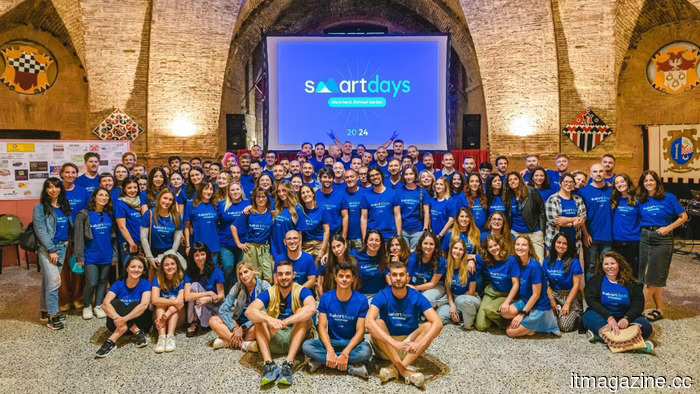 Trentino-based Smartness secures €47 million to expand its AI operations.
The Smartness tech travel startup, located in Trentino, has successfully secured €47 million in a Series B funding round to expand its AI operations.
Trentino-based Smartness secures €47 million to expand its AI operations.
The Smartness tech travel startup, located in Trentino, has successfully secured €47 million in a Series B funding round to expand its AI operations.
 Why the EU is currently seeking access to Anthropic's Mythos.
Eurogroup finance ministers convened to talk about gaining access to Anthropic's Mythos AI model, following the White House's decision to halt Anthropic's intended expansion.
Why the EU is currently seeking access to Anthropic's Mythos.
Eurogroup finance ministers convened to talk about gaining access to Anthropic's Mythos AI model, following the White House's decision to halt Anthropic's intended expansion.
The reason the EU is currently insisting on access to Anthropic's Mythos.
Eurogroup finance ministers convened to talk about gaining access to Anthropic's Mythos AI model, following the White House's decision to halt Anthropic's intended expansion.