

OpenAI's Codex application: When your IDE acquires intelligence.
OpenAI has provided software developers with a new desktop tool, and early feedback suggests it may resemble the Swiss Army knife that coders have long desired, or perhaps a gadget that makes them feel like they're collaborating with a robot colleague.
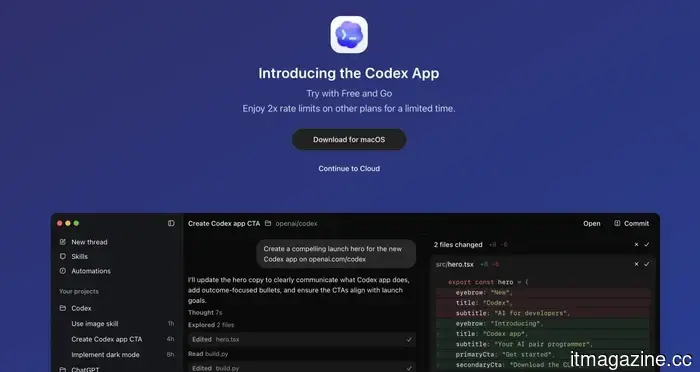
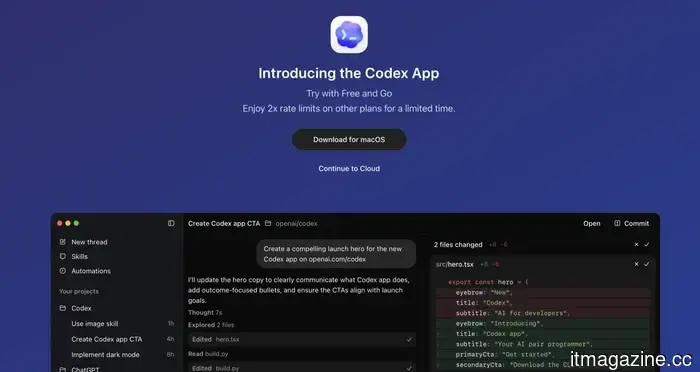
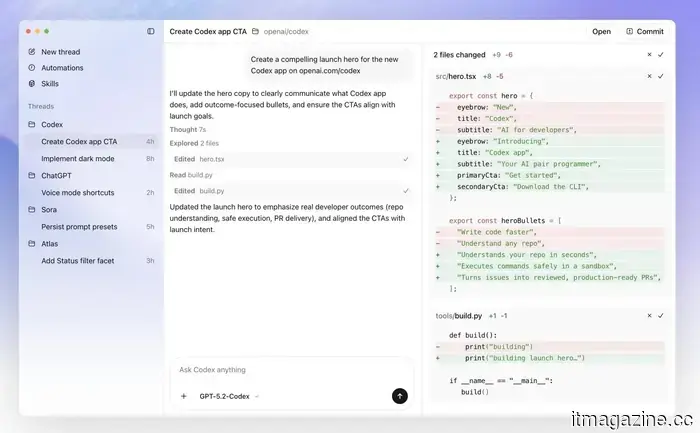
The company has introduced the Codex app for macOS, which offers a streamlined interface to manage AI coding agents, allowing developers to do more than simply “generate a few lines of code.” Codex can handle multiple tasks simultaneously, execute background processes, and follow instructions that might take hours or even days to complete.
At its essence, this new app responds to a change that has been gradually emerging over the past year: AI is no longer limited to assisting in writing short snippets; it is now capable of taking on entire coding projects, running tests, managing pull requests, and performing repetitive maintenance tasks that often frustrate developers.
With features like containers, threads, isolated worktrees, and integrated Git tools, the app facilitates a seamless experience, enabling engineers to keep a multitude of AI agents moving forward without the need to switch between terminals, IDEs, and cloud consoles.
OpenAI’s announcement highlights this transformation: existing tools were designed for real-time interaction or singular tasks, but today's coding workflows are complex and expansive. Rather than coaxing a model to produce code line by line, the Codex app allows you to coordinate agents that independently work on various segments of a codebase.
Each agent operates within its own thread and worktree, enabling exploration of multiple concepts without the concern of one agent overwriting the progress of another. Whether you want Codex to review differences, add comments, or propose changes in your local editor, it’s capable of doing so. It can even operate in the background while you rest.
The app also includes support for what OpenAI labels as “skills” and “automations,” which are reusable workflows that enable Codex to extend beyond mere code generation to tasks like information gathering, problem solving, executing scheduled operations, or conducting routine reviews.
In early tests, Codex has managed to develop complete applications, assuming the roles of designer, developer, and QA tester in just a single sequence of prompts, showcasing a shift where AI transforms from an assistant to a more collaborative team member fueled by endless coffee.
However, it's important to mention that the current release is exclusive to macOS, which has led to the typical complaints from developers regarding the absence of support for Windows and Linux. Initial users on Reddit and other platforms remarked that the lack of cross-platform availability feels somewhat outdated for an AI tool, even as they acknowledged the significant capabilities of the Codex app compared to traditional command-line interfaces.
OpenAI is also making the offering more appealing: for a limited time, Codex will be accessible to free and Go users, and rate limits for paid Plus, Pro, Business, Enterprise, and Edu plans have been doubled across all platforms where Codex operates, including the app, CLI, IDE extensions, or cloud threads.
The company’s broader strategy is evident. AI coding assistants are fiercely competitive in the generative AI landscape, with rivals like Anthropic’s Claude Code already reporting impressive revenue figures in this domain.
The introduction of a desktop command center for Codex signals OpenAI’s intention to dominate the market, not merely to release new features.
So what implications does this have for developers? It doesn’t indicate that humans will be replaced imminently. Codex is indeed powerful, but like all AI tools, it is capable of errors and requires human supervision, particularly when quality and stakes are critical.
Viewed through this perspective, the Codex app is more a robust collaboration layer than a magical solution, potentially transforming how engineering teams function without claiming to completely automate the software development process.
In practical terms, this suggests a future where managing AI agents is as routine as managing packages or Git branches. Rather than the terminal being the focal point of your workflow, Codex and its agents might assume that role, responding to prompts, executing scheduled tasks, and even adopting customizable “personalities” that match your working style.
At a time when discussions regarding AI productivity often revolve around job displacement or disruption, the Codex app signals a more nuanced possibility: what occurs when coding tools become partners instead of mere assistants?
The answer won’t be immediate, and the work will still require human insight, but many developers caught a glimpse of that future today.
Other articles
 OpenAI's Codex application: When your integrated development environment gains intelligence.
OpenAI's latest Codex desktop application transforms AI into a multi-agent coding collaborator, revolutionizing workflows with significant productivity possibilities.
OpenAI's Codex application: When your integrated development environment gains intelligence.
OpenAI's latest Codex desktop application transforms AI into a multi-agent coding collaborator, revolutionizing workflows with significant productivity possibilities.
 SpaceX and xAI: A combination of aspirations, perception, and lingering inquiries.
SpaceX’s purchase of xAI might seem like a grand cosmic strategy, yet it primarily serves as a narrative tactic for a major IPO.
SpaceX and xAI: A combination of aspirations, perception, and lingering inquiries.
SpaceX’s purchase of xAI might seem like a grand cosmic strategy, yet it primarily serves as a narrative tactic for a major IPO.
 OpenAI's Codex application: When your Integrated Development Environment gains intelligence
OpenAI's latest Codex desktop application transforms AI into a multi-agent coding collaborator, redefining workflows with genuine productivity possibilities.
OpenAI's Codex application: When your Integrated Development Environment gains intelligence
OpenAI's latest Codex desktop application transforms AI into a multi-agent coding collaborator, redefining workflows with genuine productivity possibilities.
OpenAI's Codex application: When your IDE acquires intelligence.
OpenAI's latest Codex desktop application transforms AI into a multi-agent coding collaborator, altering workflows with significant productivity possibilities.